By

August 10, 2026
What Is the Difference Between UK Import Duty and Import VAT?
If your business imports goods into the UK, you may encounter two important charges: Import Duty and Import VAT.
Although both can arise when goods enter the UK, they are different. Import Duty is a customs charge that can apply to imported goods, while Import VAT is VAT applied to imports.
Understanding the difference can help UK businesses calculate import costs correctly, manage cash flow and avoid unexpected charges when goods arrive.
Import Duty, often referred to as Customs Duty, is a charge that may apply when goods are imported into the UK.
Whether Customs Duty applies and how much is payable can depend on factors such as:
Not every product has the same duty rate. Some products may have no Customs Duty, while others can attract different rates.
Because tariff rates can change, importers should check the current UK Trade Tariff on GOV.UK before importing goods.
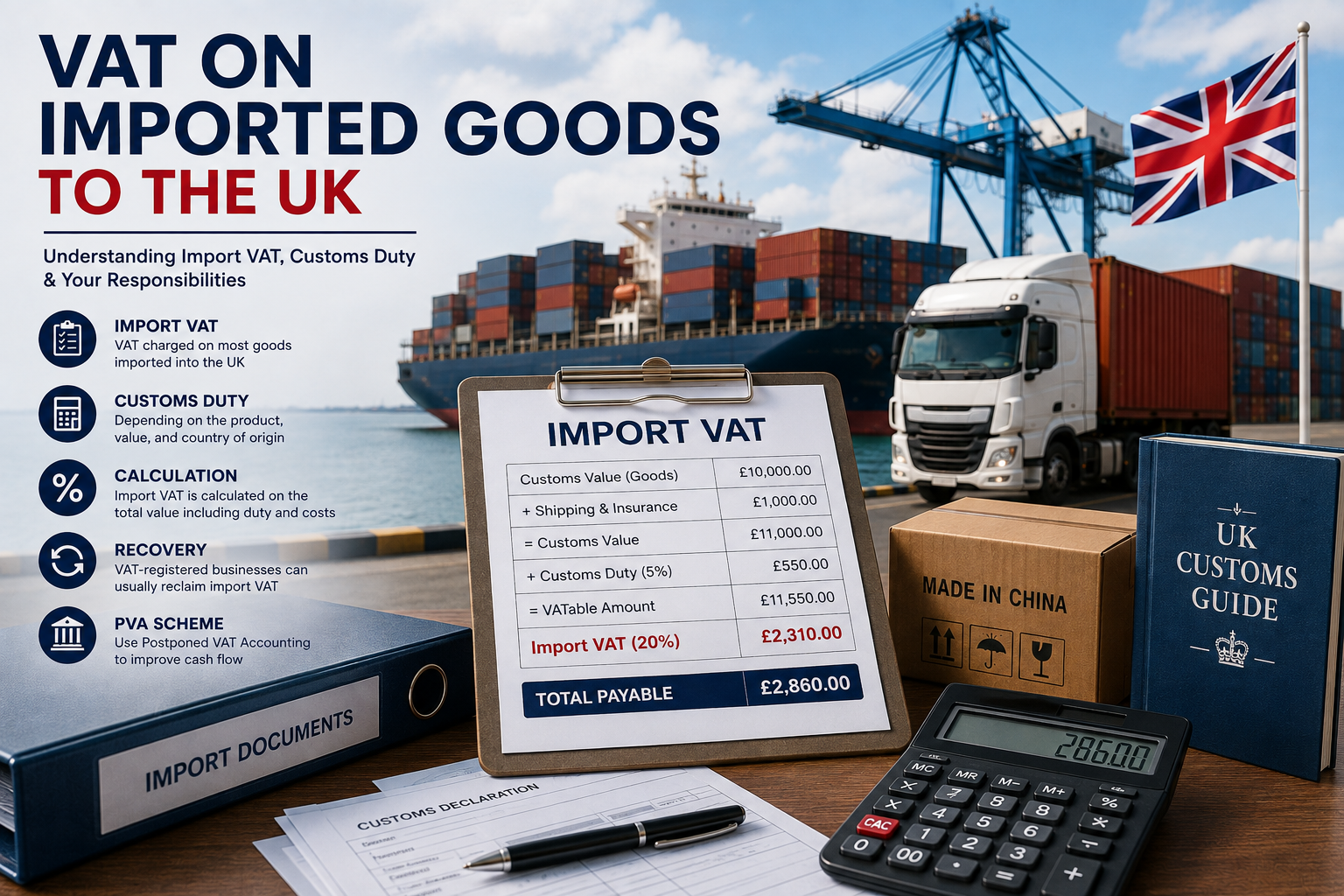
Import VAT is VAT that may apply when goods are imported into the UK.
It is separate from Customs Duty.
This means that even if no Customs Duty is payable on a particular product, Import VAT may still need to be accounted for.
For VAT-registered businesses, Import VAT may potentially be recoverable where the relevant conditions are satisfied.
The simplest distinction is:
Import Duty is a customs charge determined by factors such as the classification, customs value and origin of imported goods.
Import VAT is VAT applied to imported goods under the relevant UK VAT rules.
Another important difference concerns how the charges are treated by businesses.
Import VAT may potentially be recovered by an eligible VAT-registered business.
Customs Duty, by contrast, generally forms part of the cost of importing the goods unless a particular customs relief or repayment provision applies.
Calculating Import Duty usually starts with identifying the correct commodity code for the product.
The commodity code helps determine the tariff treatment that applies to the goods.
A simplified calculation is:
Customs value × applicable Customs Duty rate = Import Duty
However, the exact customs value and duty rate depend on the goods and circumstances.
Rather than relying on a fixed percentage quoted in an article, businesses should check the current rate using the official UK Trade Tariff.
Import VAT is calculated using the relevant value determined under UK customs and VAT rules.
This can include more than simply the amount paid to the overseas supplier.
Depending on the circumstances, the calculation may take account of:
The applicable VAT treatment should always be checked against the latest HMRC guidance.
Yes.
A shipment can potentially have no Customs Duty payable while still being subject to Import VAT.
This may happen because the applicable tariff treatment results in no Customs Duty, while VAT rules still apply to the import.
This is why importers should calculate Import Duty and Import VAT separately rather than treating them as a single charge.
A VAT-registered business may be able to recover Import VAT where the relevant conditions are satisfied.
The business generally needs appropriate evidence supporting the Import VAT and must comply with HMRC's requirements for input tax recovery.
The correct business should also be identified as the importer.
Maintaining accurate customs and VAT records is therefore particularly important for businesses that regularly import goods.
Import Duty is treated differently from Import VAT.
Customs Duty generally forms part of the cost of importing goods and cannot simply be reclaimed through a VAT return.
However, customs reliefs, repayment procedures and special customs arrangements may be available in certain circumstances.
Importers should therefore consider Customs Duty when calculating the landed cost of their products.
Postponed VAT Accounting (PVA) is a mechanism that may allow eligible VAT-registered businesses to account for Import VAT through their VAT return rather than paying it upfront when goods enter the UK.
This can help businesses manage cash flow when importing goods.
Businesses using PVA need to follow HMRC's current requirements and maintain the appropriate records and statements.
Because VAT procedures can change, importers should check the latest HMRC guidance before relying on a particular accounting method.
A business being outside the VAT registration system does not necessarily mean that Import VAT will not arise.
Import VAT may still apply when goods are brought into the UK.
However, a business that is not VAT registered generally does not recover Import VAT through a VAT return in the same way as an eligible VAT-registered business.
Import VAT can therefore become an important component of the cost of imported goods.
A commodity code is used to classify products for customs purposes.
The correct commodity code can determine:
Choosing the correct commodity code is therefore one of the most important steps when importing goods.
Businesses can search for current commodity classifications using the UK Trade Tariff on GOV.UK.
Yes.
The country of origin can affect the Customs Duty treatment of imported products.
The UK has trading arrangements with various countries and territories that may provide preferential tariff treatment for qualifying goods.
However, the country from which goods are shipped is not necessarily their country of origin.
For example, products dispatched from a warehouse in one country may have been manufactured in another.
Importers should establish the correct customs origin and determine whether the goods satisfy any applicable rules of origin.
UK businesses importing goods from China should consider several costs before placing an order.
These may include:
The applicable Customs Duty depends on the classification and customs treatment of the particular product.
Import VAT should be considered separately.
Goods entering Great Britain from the EU may also be subject to customs procedures and Import VAT.
Some qualifying products may benefit from preferential Customs Duty treatment where the applicable rules are satisfied.
However, purchasing products from an EU supplier does not automatically establish the customs origin of those goods.
Importers should check the product's actual origin and applicable rules before assuming that preferential duty treatment applies.
Consider a UK business importing a commercial shipment from an overseas supplier.
The business would first determine the customs value of the shipment.
It would then identify the correct commodity code and check the current Customs Duty treatment.
If Customs Duty applies, that charge would normally become part of the cost associated with importing the products.
Import VAT would then be determined separately according to the applicable VAT valuation rules.
If the business is VAT registered and meets the relevant conditions, it may potentially recover the Import VAT.
The key point is that Import Duty and Import VAT are calculated and treated separately.
Understanding both charges is essential when calculating the landed cost of imported products.
Landed cost can include:
Product cost + freight + insurance + Customs Duty + customs clearance + handling + delivery + other applicable import costs
Import VAT should also be considered, particularly where it cannot be recovered or where it creates a temporary cash-flow requirement.
Calculating landed cost before purchasing products helps businesses determine whether an imported product will actually be profitable.
UK Import Duty
Import Duty is a customs charge that may apply to imported goods. Its treatment depends on factors including the product classification, customs value and origin.
It generally becomes part of the cost of importing goods unless a specific relief or repayment arrangement applies.
UK Import VAT
Import VAT is VAT that may apply when goods are imported into the UK.
It is separate from Customs Duty and may apply even where no Customs Duty is payable.
Eligible VAT-registered businesses may potentially recover Import VAT where the relevant conditions are satisfied.
Because tax rates, tariffs, trade agreements and customs procedures can change, businesses should avoid relying on old figures found in articles or online discussions.
Before importing goods, check the latest information through official UK government sources.
The UK Trade Tariff on GOV.UK can be used to check current:
HMRC guidance should also be checked for current information regarding Import VAT, customs valuation and Postponed VAT Accounting.
The main difference between UK Import Duty and Import VAT is that they are two separate types of import charge.
Import Duty is generally determined by factors such as the product's classification, value and origin, while Import VAT is VAT applied to imported goods under the relevant VAT rules.
Import VAT may potentially be recovered by an eligible VAT-registered business, whereas Customs Duty generally forms part of the cost of importing the goods.
For UK importers, understanding both charges is essential when calculating landed costs and determining whether importing a product will be profitable.
Always check the latest HMRC guidance and UK Trade Tariff on GOV.UK before calculating Import Duty or Import VAT.
This article is for general information only and does not constitute customs, tax, accounting or legal advice. Import rules and tax treatment can change and depend on the circumstances of each transaction