By

August 8, 2026
VAT on Imported Goods to the UK
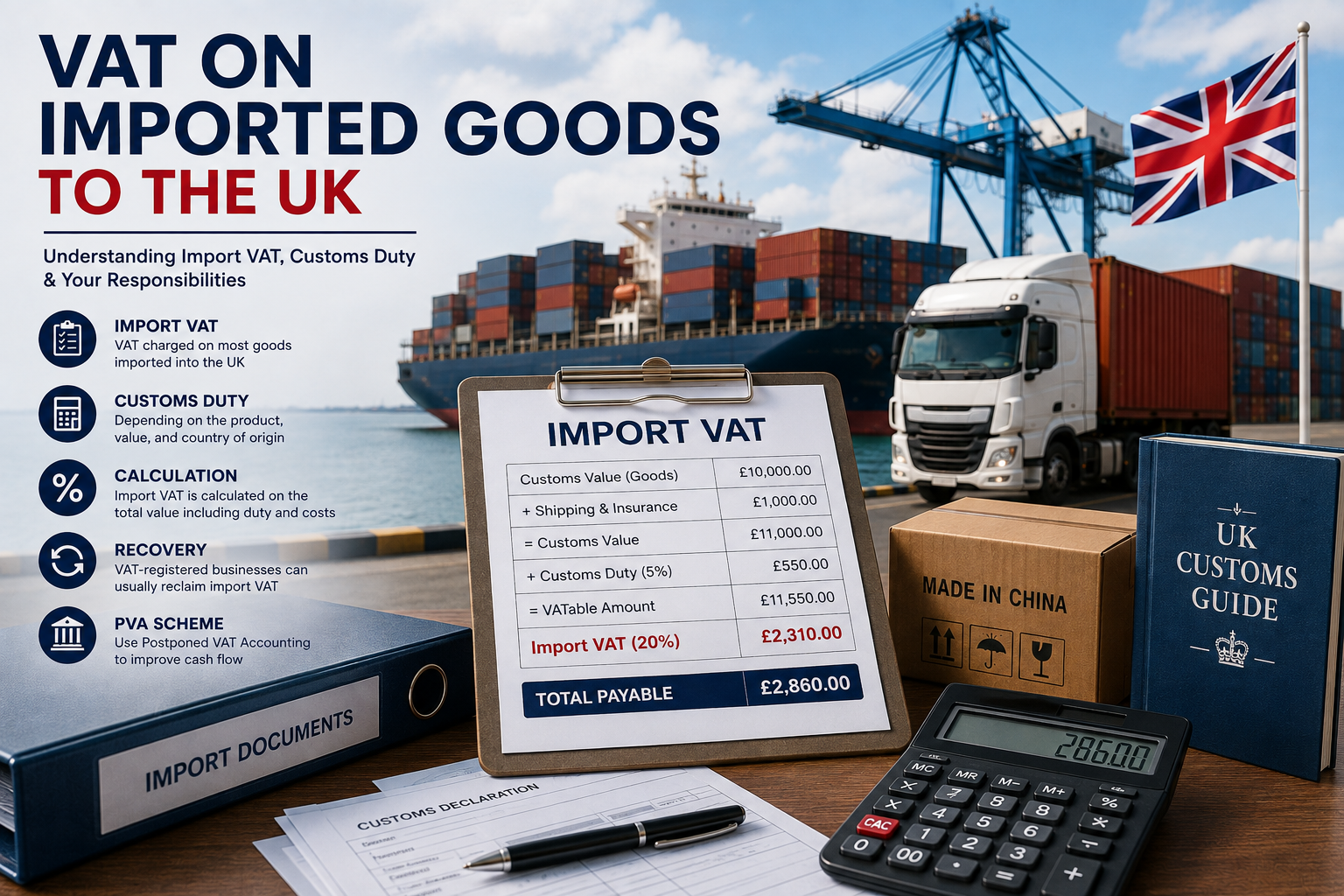
When goods are imported into the UK, import VAT may become payable as part of the customs process. For businesses buying products from overseas suppliers, understanding how VAT on imported goods works is essential for calculating costs, managing cash flow and completing VAT returns correctly.
Import VAT is separate from Customs Duty. Even when no Customs Duty is payable on a product, VAT may still apply when the goods enter the UK.
This guide explains VAT on imported goods to the UK, including how import VAT is calculated, when it is payable, how VAT-registered businesses may recover it and how Postponed VAT Accounting can help businesses manage cash flow.
Import VAT is VAT charged when goods are imported into the UK from overseas.
It operates differently from the VAT you may normally pay when purchasing goods from a UK supplier.
When goods cross the UK border, their import VAT treatment is determined as part of the customs process.
The amount payable depends on factors including:
Importers should therefore calculate potential VAT before placing significant international orders.
VAT can apply to goods imported into the UK.
However, the exact VAT treatment depends on the type of goods and circumstances of the import.
Many goods are subject to the standard UK VAT rate of 20%, while some goods may qualify for reduced or zero-rated treatment.
The VAT rate applicable to an imported product will generally reflect the VAT treatment that would apply to equivalent goods supplied domestically.
Importers should check the correct VAT treatment for their particular products rather than automatically assuming every shipment is taxed at 20%.
Import VAT and Customs Duty are two different charges.
This distinction is important.
Customs Duty is a tariff that may apply to imported goods based on factors such as their commodity code, customs value and country of origin.
Import VAT is VAT charged on imported goods.
A shipment can therefore have:
A product having a 0% Customs Duty rate does not automatically mean that no import VAT is due.
Import VAT is not necessarily calculated only on the supplier's invoice price.
The VAT value can include several elements associated with importing the goods.
Depending on the circumstances, this may include:
This means the amount on which VAT is calculated can be higher than the amount originally paid to the overseas supplier.
Suppose a UK business imports goods with a customs value of:
£10,000
Assume the applicable Customs Duty is:
5%
Customs Duty would be:
£10,000 × 5% = £500
For a simplified example, assume import VAT at 20% is calculated on:
£10,500
The import VAT would therefore be:
£10,500 × 20% = £2,100
The simplified taxes would be:
Customs Duty: £500
Import VAT: £2,100
Total: £2,600
This example excludes additional costs that could affect the actual VAT calculation.
Businesses should calculate the VAT value using the applicable customs and VAT rules for their specific shipment.
Understanding customs value is important because it can affect both Customs Duty and import VAT.
The customs value is not necessarily identical to the price shown on the supplier's invoice.
Depending on the applicable valuation method, it can include:
Importers should ensure that goods are valued correctly when making customs declarations.
Deliberately undervaluing goods to reduce VAT or Customs Duty can result in penalties and other consequences.
UK businesses frequently import products from China.
When goods arrive from China, the importer should consider:
Import VAT can apply even if the applicable Customs Duty rate is 0%.
For businesses sourcing products from China, VAT should therefore be considered when calculating the true landed cost of inventory.
Imagine a UK ecommerce company purchases products from a Chinese manufacturer.
Product cost: £15,000
International shipping and qualifying costs: £2,000
Assume the relevant customs value for this simplified illustration is:
£17,000
If Customs Duty were 4%:
£17,000 × 4% = £680
Assuming import VAT at 20% were calculated on £17,680:
£17,680 × 20% = £3,536
The company could therefore have a substantial import VAT amount associated with the shipment.
For VAT-registered businesses, the way this VAT is accounted for can have an important effect on cash flow.
Following Brexit, goods entering Great Britain from EU countries generally go through customs procedures.
Import VAT can therefore apply when goods are imported from the EU into Great Britain.
This is different from the VAT treatment that existed before the UK's departure from the EU.
Businesses purchasing inventory from suppliers in countries such as:
should determine the correct import VAT and customs treatment.
Customs Duty may potentially be reduced or eliminated for qualifying originating goods under applicable UK-EU trade arrangements, but this does not automatically remove import VAT.
Goods imported from the United States can also be subject to UK import VAT.
The same general principles apply.
Businesses should determine:
Import VAT should be included when estimating the total financial impact of importing products from the USA.
Postponed VAT Accounting, commonly known as PVA, is an important system for VAT-registered UK businesses importing goods.
It can allow eligible businesses to account for import VAT through their VAT return rather than paying the VAT upfront at the border and reclaiming it later.
This can provide a significant cash-flow advantage.
Without PVA, a company importing a large shipment could potentially have thousands of pounds tied up in import VAT.
With PVA, eligible import VAT can instead be accounted for through the VAT return.
Consider a VAT-registered business with £10,000 of eligible import VAT.
Without postponed accounting, the business might have to pay the import VAT as part of the import process and subsequently seek to recover the eligible amount through its VAT return.
This creates a temporary cash-flow cost.
With PVA, the business can account for the import VAT on its VAT return, subject to the applicable rules.
Where the VAT is fully recoverable, the accounting entries can largely offset each other on the same VAT return.
This can significantly reduce the cash-flow impact of importing goods.
PVA is intended for VAT-registered businesses importing goods where the applicable requirements are met.
Businesses should ensure the correct information is entered on customs declarations so the import is handled appropriately.
Your customs agent or freight forwarder should know whether you intend to use PVA.
However, the importer should still verify that declarations are being made correctly.
Businesses using PVA can access postponed import VAT statements.
These statements provide information about import VAT accounted for through postponed accounting.
Businesses should retain these statements as part of their VAT records and use the relevant figures when preparing VAT returns.
Good record keeping is particularly important for companies importing frequently.
VAT-registered businesses may be able to recover eligible import VAT, subject to the normal VAT recovery rules.
Several conditions can affect recovery.
For example, the business should generally:
If goods are used partly for exempt or non-business purposes, the amount recoverable may be restricted.
Businesses should obtain professional advice where their VAT position is complicated.
Generally, a business that is not VAT registered cannot recover import VAT through a VAT return in the same way as a VAT-registered business.
This means import VAT can become a real cost to the business.
For example, if a non-VAT-registered company imports £20,000 of inventory and incurs several thousand pounds of import VAT, that VAT may increase the effective cost of the products.
This should be considered carefully when calculating profit margins.
Businesses importing products should calculate their landed cost.
A simplified landed-cost calculation can include:
Product Cost + Freight + Insurance + Customs Duty + Unrecoverable Import VAT + Customs Clearance + Handling + UK Delivery
Whether import VAT should be treated as a permanent cost depends on whether the business can recover it.
For a VAT-registered business entitled to full recovery, import VAT may primarily represent a VAT accounting and cash-flow issue.
For a business unable to recover it, import VAT becomes part of the economic cost of the goods.
Special VAT rules can apply to certain lower-value consignments sold to UK consumers.
For some consignments with a value of £135 or less, VAT may be collected at the point of sale rather than at the border.
Depending on the transaction, responsibility for collecting VAT could fall on:
Different rules can apply to business-to-business transactions where the customer provides appropriate VAT information.
Because ecommerce VAT rules can be complex, overseas sellers targeting UK consumers should understand their VAT obligations before accepting orders.
For consignments above the relevant £135 threshold, normal import VAT and customs procedures will generally become more relevant.
The importer may need to deal with:
The exact treatment depends on the goods and transaction.
Responsibility can depend on the commercial arrangements and Incoterms agreed between the buyer and seller.
Common Incoterms include:
For example, under DAP arrangements, the buyer generally deals with import clearance and applicable import taxes.
Under DDP arrangements, the seller assumes extensive responsibility for import formalities and duties according to the agreed terms.
However, VAT-registered businesses should still carefully examine who is acting as importer and how import VAT is documented.
DDP shipping can appear convenient because the supplier arranges most of the delivery process.
However, UK businesses should not assume that every DDP shipment provides the documentation necessary to recover VAT.
Before accepting DDP terms, establish:
This is especially important for VAT-registered companies.
Businesses should maintain appropriate customs and VAT records.
Depending on the import, documents can include:
Records should be accurate and retained in accordance with applicable tax requirements.
Shipping and related costs can affect the amount used to calculate import VAT.
The precise treatment depends on where the costs arise and how the customs and VAT valuation rules apply.
Importers should therefore avoid simply calculating VAT on the supplier's product price without considering transport and other qualifying costs.
Import VAT is particularly important for ecommerce companies that purchase inventory overseas.
Imagine an online store importing products from China.
The business needs to consider:
Understanding whether import VAT is recoverable can significantly affect product pricing and margins.
A newly incorporated UK limited company can import goods.
However, the company should determine its customs and VAT position before ordering inventory.
Important questions include:
Addressing these questions before shipment can prevent expensive surprises.
They are separate charges and should be calculated separately.
Import VAT can have a major impact, particularly where it cannot be recovered.
VAT calculations can depend on customs valuation rules rather than simply the supplier invoice.
A 0% Customs Duty rate does not automatically remove import VAT.
Customs declarations and VAT returns must be completed appropriately when postponed accounting is used.
Missing customs and VAT documentation can create problems when attempting to recover import VAT.
Always establish who is acting as importer and what evidence your business will receive.
Businesses should not attempt to avoid legitimate import VAT by undervaluing or incorrectly declaring goods.
However, there are legitimate ways to manage the cash-flow impact.
VAT-registered businesses can consider:
For businesses importing significant volumes, good VAT planning can make a meaningful difference to cash flow.
Before importing goods into the UK, check:
Completing these checks before shipment can help prevent unexpected tax costs.
Many standard-rated goods are subject to the standard UK VAT rate of 20%, but the applicable VAT rate depends on the type of product. The amount on which VAT is calculated can also include Customs Duty and certain additional costs.
Import VAT can apply when goods are imported from China into the UK.
Import VAT can apply to goods entering Great Britain from EU countries following Brexit.
VAT-registered businesses may be able to recover eligible import VAT subject to the normal VAT rules and appropriate documentation.
PVA allows eligible VAT-registered businesses to account for import VAT through their VAT return instead of paying it upfront and reclaiming it later.
No. They are separate taxes.
Potentially, yes. A 0% Customs Duty rate does not automatically mean the import is free from VAT.
EORI requirements relate to customs identification. Businesses importing commercial goods will commonly need the appropriate EORI registration regardless of how import VAT is accounted for.
Understanding VAT on imported goods to the UK is essential for any business buying products internationally.
Import VAT can significantly affect the cost and cash flow associated with importing goods, particularly for businesses that are not VAT registered or cannot fully recover VAT.
VAT-registered businesses should understand whether Postponed VAT Accounting can be used to reduce the upfront cash-flow impact of import VAT.
Before importing, determine the correct commodity code, customs value, VAT rate, Customs Duty treatment and who will act as the importer.
Most importantly, calculate the complete landed cost of your products before placing significant overseas orders.
Careful planning can help businesses avoid unexpected VAT charges, maintain accurate records and better understand the true cost of importing products into the UK.
This article is for general information only and does not constitute tax, customs, legal or financial advice. VAT and customs rules can change, so businesses should check current HMRC guidance or obtain professional advice where appropriate.