By

August 8, 2026
UK Customs & Customs Clearance: Complete Guide for Importers
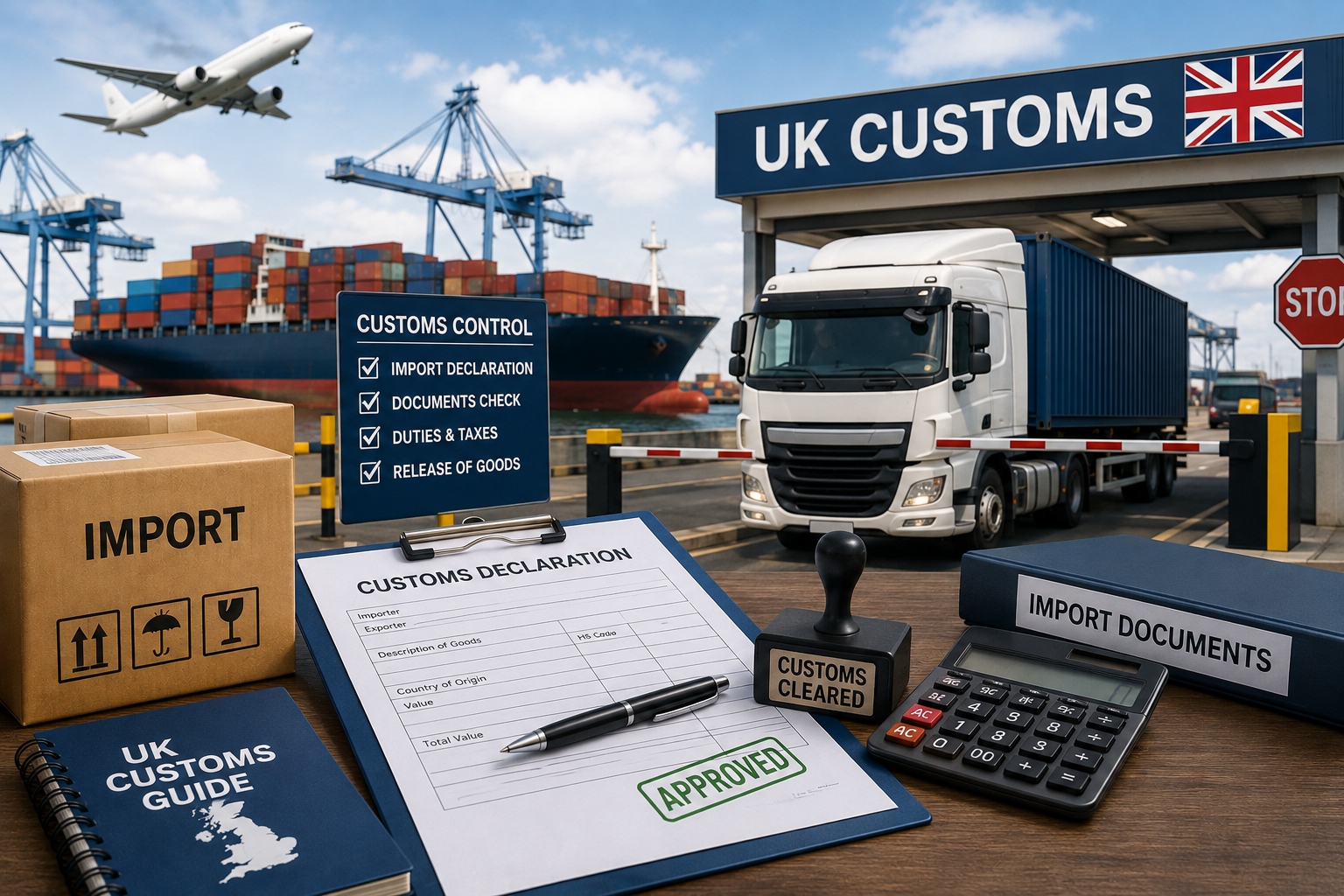
Importing goods into the United Kingdom involves more than arranging international shipping. Goods entering the country may need to pass through UK Customs, where customs declarations, duties, VAT and other import requirements are handled before the shipment can be released.
For businesses importing products from China, the EU, the United States or other international markets, understanding UK customs clearance can help prevent unexpected charges, documentation problems and delays at the border.
This guide explains how customs clearance works in the UK, the documents importers may need, Customs Duty and import VAT, EORI numbers, commodity codes and how businesses can prepare shipments for UK Customs.
UK Customs refers broadly to the system responsible for controlling goods entering and leaving the United Kingdom.
HM Revenue & Customs (HMRC) plays a central role in administering customs requirements and collecting applicable duties and taxes.
When goods are imported, customs authorities may need information about:
This information helps determine whether goods can enter the country and whether taxes, duties, restrictions or other requirements apply.
Customs clearance is the process of completing the required customs formalities so imported or exported goods can proceed through the border.
For imports, this commonly involves submitting information about the shipment, determining the correct commodity code, declaring the customs value and accounting for any applicable taxes and duties.
Once the necessary customs requirements have been satisfied, the goods can normally be released for onward delivery.
For UK businesses importing commercial goods, customs clearance is an important part of the international supply chain.
The exact process depends on the goods, origin, transport method and customs procedure.
A typical import may involve the following steps:
Straightforward shipments with accurate documentation may clear relatively quickly, while shipments requiring inspections or additional information can take longer.
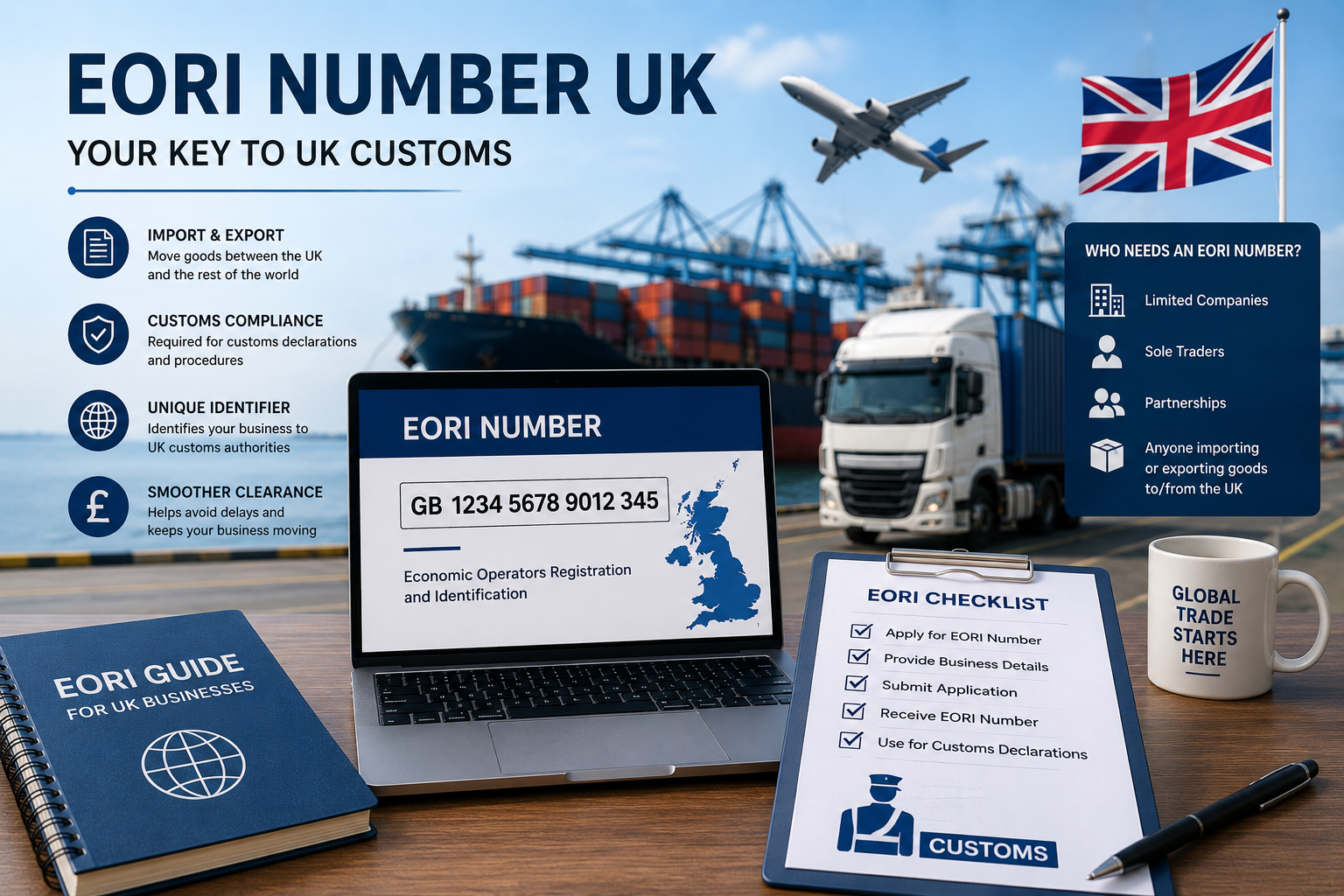
Businesses involved in importing or exporting goods will commonly need an EORI number.
EORI stands for:
Economic Operators Registration and Identification
The number is used to identify businesses when dealing with customs authorities.
Businesses importing goods into Great Britain should check which EORI number they require before arranging shipments.
An EORI number may be required for activities such as:
Businesses should arrange the necessary registration before their first shipment wherever possible.
A customs declaration provides authorities with information about goods being imported or exported.
The declaration can include information such as:
The information must be accurate.
Incorrect customs declarations can lead to delays, additional taxes, penalties or other problems.
Every product imported into the UK needs to be correctly classified for customs purposes.
A commodity code is used to identify the type of goods.
The classification can determine:
For example, electronics, clothing, machinery, toys, furniture and food products can all have different commodity classifications.
Businesses can use the UK Trade Tariff to identify the appropriate commodity code.
Selecting the correct code is one of the most important parts of customs clearance.
There is no single Customs Duty rate for all goods entering the UK.
The amount depends on factors including:
Some products can have a 0% Customs Duty rate, while others attract a percentage-based tariff.
For example, if an imported product had an applicable customs value of £20,000 and a Customs Duty rate of 5%, a simplified calculation would be:
£20,000 × 5% = £1,000
The Customs Duty would therefore be £1,000 in this simplified example.
Actual customs valuation can include additional costs and should be calculated according to the applicable rules.
Customs Duty is generally calculated using the customs value of the imported goods.
This is not necessarily limited to the supplier's invoice price.
Depending on the applicable valuation method, customs value can potentially include:
Importers should ensure the value declared to customs is accurate and supported by appropriate documentation.
Deliberately undervaluing goods to reduce import taxes is not a legitimate way to reduce customs costs.
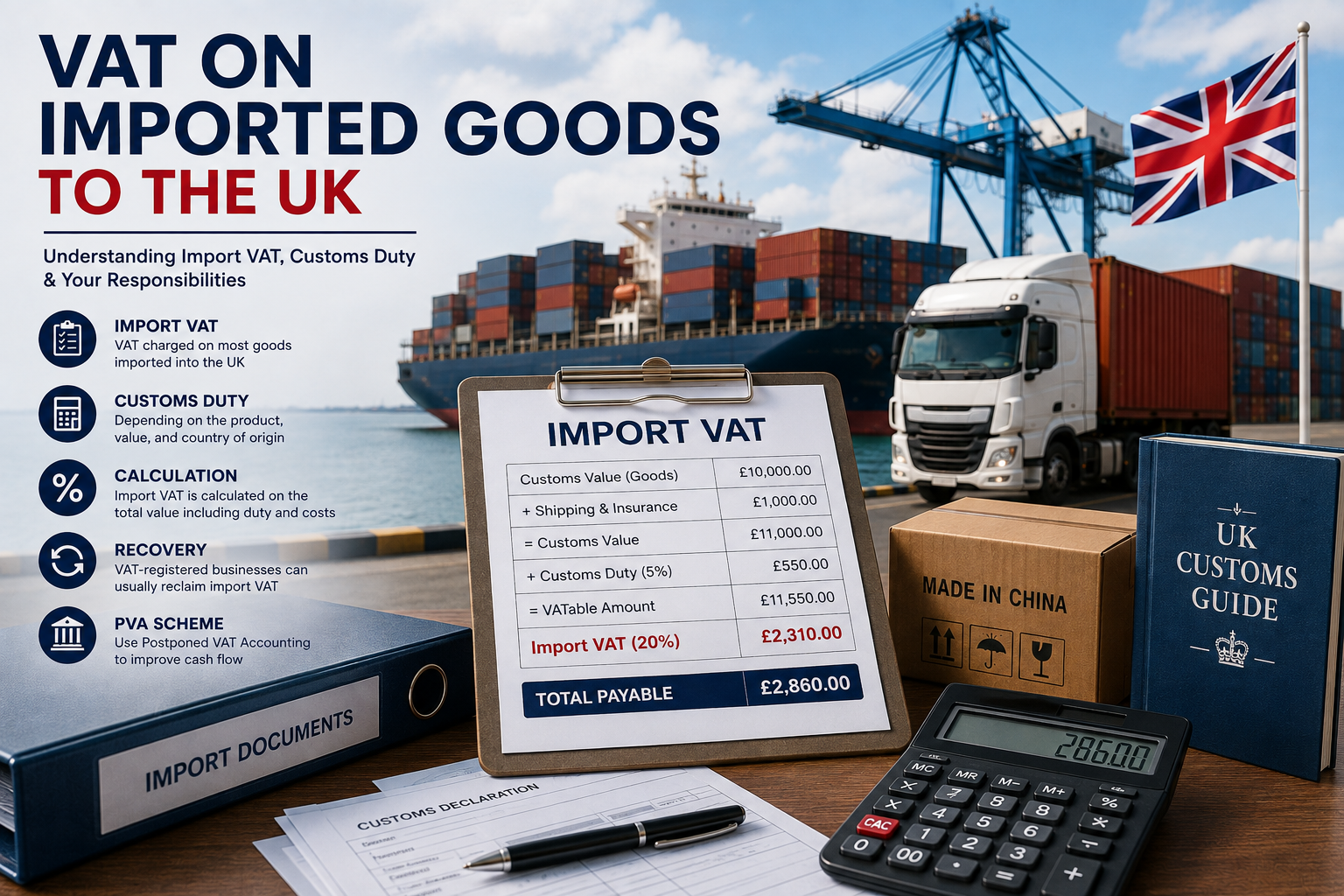
Import VAT is VAT charged on goods entering the UK.
It is separate from Customs Duty.
A product can therefore have a 0% Customs Duty rate but still be subject to import VAT.
The amount on which import VAT is calculated can include:
For many standard-rated goods, the standard UK VAT rate applies.
However, VAT treatment depends on the type of goods and circumstances.
Consider a simplified example where a UK company imports goods with a customs value of:
£10,000
Assume the applicable Customs Duty rate is:
5%
Customs Duty:
£10,000 × 5% = £500
For illustration, if import VAT at 20% were calculated on £10,500:
£10,500 × 20% = £2,100
The illustrated taxes would be:
Customs Duty: £500
Import VAT: £2,100
Total: £2,600
Additional charges may include:
Actual costs depend on the shipment and customs arrangements.
For VAT-registered UK businesses, Postponed VAT Accounting (PVA) can be particularly useful.
Eligible businesses can account for import VAT through their VAT return rather than physically paying eligible import VAT at the point of import and reclaiming it later.
This can improve cash flow.
For example, a business importing a large shipment could otherwise need to pay a significant amount of import VAT before receiving or selling the goods.
Businesses using PVA should ensure their customs declarations and VAT records are completed correctly.
VAT-registered UK businesses may be able to recover eligible import VAT, subject to the normal VAT rules.
Appropriate records and evidence are required.
The business should also ensure that its role as importer and the customs documentation are structured correctly.
For businesses that are not VAT registered, import VAT may represent a direct cost rather than an amount that can normally be recovered through a VAT return.
The documents required depend on the shipment.
Common documents can include:
The commercial invoice normally provides information such as:
A packing list provides information about how the shipment is packed.
It can include:
Depending on the shipping method, this could include documents such as:
The importer may need the appropriate EORI number.
Evidence of origin may be required when claiming preferential tariff treatment under a trade agreement.
Certain products may require additional documentation.
Examples can include:
Importers should identify any special requirements before the goods are shipped.
Businesses do not necessarily need to prepare every customs declaration themselves.
Many importers use a:
These organisations can help prepare and submit customs declarations.
However, using an agent does not mean businesses should ignore customs requirements.
Importers should understand the information being declared on their behalf and provide accurate documentation.
A customs broker helps businesses manage customs declarations and clearance procedures.
A broker may assist with:
Businesses importing regularly may find working with an experienced customs broker particularly useful.
Brokerage services involve additional fees, which should be included when calculating the total landed cost of imports.
There is no guaranteed customs clearance time for every shipment.
Some goods can clear quickly when the documentation is complete and no additional checks are required.
Others can be delayed because of:
Businesses should therefore avoid planning inventory around the assumption that every shipment will clear immediately.
A shipment being held does not necessarily mean there is a serious problem.
Customs or the carrier may require additional information before the goods can be released.
Common reasons include:
Contact your courier, freight forwarder or customs representative to determine what is required.
Businesses importing products from China commonly need to deal with UK customs clearance.
The process can involve:
Importers should calculate these costs before placing an order with a Chinese supplier.
A low factory price does not necessarily mean a low final product cost once freight, customs and UK delivery are included.
Following Brexit, goods moving from the EU into Great Britain generally require customs formalities.
Businesses importing from EU countries should therefore understand the customs requirements that apply to their shipments.
However, qualifying goods may benefit from preferential tariff treatment under the UK-EU Trade and Cooperation Agreement where the relevant rules of origin are satisfied.
Importers should not confuse:
Country of dispatch with country of origin.
Goods shipped from an EU warehouse do not automatically have EU origin.
Goods imported from the United States also need to comply with UK customs requirements.
Businesses should determine:
The same principle applies to imports from other countries outside the UK.
A product's country of origin can affect the Customs Duty payable.
Origin does not simply mean the country from which the package was shipped.
For customs purposes, origin generally relates to where the goods were produced or sufficiently processed according to applicable rules.
Rules of origin become particularly important when a business wants to claim preferential tariff treatment under a trade agreement.
Importers should retain appropriate evidence supporting any preferential origin claim.
International suppliers frequently use Incoterms to define certain responsibilities between buyers and sellers.
Common Incoterms include:
The agreed Incoterm can affect who arranges transportation, insurance, export procedures and import formalities.
Before agreeing to an international order, understand exactly which costs and responsibilities are included in the supplier's quote.
DDP stands for Delivered Duty Paid.
Under DDP terms, the seller assumes extensive responsibility for delivering the goods to the agreed destination, including dealing with import formalities and applicable duties according to the Incoterm.
DDP can appear convenient to UK buyers.
However, businesses should still establish:
This is particularly important for VAT-registered businesses that need accurate records.
DAP means Delivered at Place.
Under DAP, the seller arranges transportation to an agreed destination, but the buyer generally takes responsibility for import clearance and associated import taxes.
This means the UK buyer may need to arrange or pay for:
Always check the exact agreed Incoterm and contractual arrangements.
In addition to government taxes, businesses may need to pay private service fees.
These can include:
These fees vary by provider and shipment.
When comparing international shipping quotations, ask whether customs clearance and destination charges are included.
Importers can reduce the risk of delays by preparing carefully.
Before shipping:
Use the correct commodity code.
Correct classification helps determine the appropriate duty and regulatory requirements.
Provide accurate product descriptions.
Avoid vague descriptions such as "parts," "samples" or "goods."
Declare the correct value.
Make sure customs values are calculated according to applicable rules.
Check your EORI number.
Ensure any required customs registration is active.
Prepare documentation.
Have invoices, packing lists and transport documents available.
Check import restrictions.
Some products require licences or certificates.
Check product compliance.
Make sure products meet applicable UK requirements before shipment.
Arrange a customs broker early.
Do not wait until the goods reach the UK before deciding who will handle clearance.
Businesses should calculate the landed cost rather than simply looking at the supplier's invoice.
A simplified calculation is:
Product Cost + Freight + Insurance + Customs Duty + Unrecoverable Import VAT + Customs Clearance + Handling + UK Delivery = Landed Cost
For example:
Goods: £15,000
Freight: £2,000
Insurance: £150
Customs Duty: £750
Customs clearance: £200
UK delivery: £400
Estimated landed cost before considering recoverable VAT:
£18,500
If the shipment contains 1,000 products, the estimated landed cost would be:
£18.50 per unit
Calculating landed cost is essential when setting retail or wholesale prices.
Businesses should avoid:
Good customs records are especially important for businesses importing regularly.
Before importing goods into the UK, check:
Completing these checks before shipment can reduce delays and unexpected costs.
There is no fixed cost. The total can include Customs Duty, import VAT and fees charged by couriers, customs brokers, ports or freight forwarders.
Straightforward shipments can clear relatively quickly, but customs inspections, documentation problems or missing payments can cause delays.
Not necessarily. However, many businesses use customs brokers or freight forwarders to handle declarations, particularly for commercial shipments.
Businesses involved in importing or exporting commercial goods commonly need an appropriate EORI number.
No. The applicable rate depends on the commodity code, customs value, origin and other factors. Some products can have a 0% duty rate.
No. They are separate charges. A product can have no Customs Duty while still being subject to import VAT.
Customs authorities can inspect goods as part of border and customs controls.
Once all necessary customs formalities have been completed and the goods are released, the shipment can normally proceed to its final destination.
Understanding UK Customs and customs clearance is essential for any business importing products into the United Kingdom.
Successful customs clearance depends on accurate documentation, correct commodity classification, appropriate customs valuation and compliance with UK import requirements.
Before shipping goods, businesses should identify the correct commodity code, obtain any required EORI number, calculate Customs Duty and import VAT, check product restrictions and determine who will handle the customs declaration.
Companies importing regularly should also consider working with experienced freight forwarders or customs professionals to help manage the process.
Most importantly, customs costs should be included when calculating the true landed cost of imported products.
Planning ahead can reduce delays, avoid unexpected charges and make international trade considerably easier to manage.
This article is for general information only and does not constitute customs, tax, legal or financial advice. UK customs procedures and requirements can change, so always check current official guidance before importing goods.