By

August 10, 2026
How Much Import Duty Will I Pay in the UK?
If you are importing goods into the UK, one of the first questions you are likely to ask is: how much import duty will I pay?
There is no single UK import duty rate that applies to every shipment. The amount of Customs Duty you may need to pay depends on several factors, particularly the type of goods, their commodity code, customs value, country of origin and any applicable tariff treatment.
Importers may also need to account for import VAT, shipping costs, customs clearance fees and other charges.
This guide explains how UK import duty works, what determines the amount you pay and how to estimate the total cost before importing goods.
Import duty commonly refers to Customs Duty charged when certain goods are imported into the UK.
It is separate from import VAT.
When goods enter the UK, customs authorities need information about what the goods are, where they originated and how much they are worth.
This information helps determine whether Customs Duty applies and, if so, how much is payable.
The answer depends on your particular goods.
There is no standard import duty percentage for all UK imports.
Depending on the product and circumstances, Customs Duty could be zero or could be charged at a percentage or other tariff rate.
The calculation generally depends on:
The first step is therefore identifying exactly what you are importing.
For goods subject to an ad valorem Customs Duty rate, a simplified calculation can be expressed as:
Customs Value × Customs Duty Rate = Customs Duty
For example, imagine the relevant customs value of a shipment is:
£10,000
and, purely for illustration, the applicable Customs Duty rate is:
5%
The calculation would be:
£10,000 × 5% = £500
The estimated Customs Duty would therefore be £500.
This is a simplified example. Actual customs calculations can be more complicated depending on the product, valuation method and applicable tariff measures.
The customs value is the value used for customs purposes.
It is not necessarily just the price shown for the products on your supplier's invoice.
Under the appropriate customs valuation rules, certain additional costs may need to be considered.
Depending on the circumstances, the customs value may take account of items such as:
The exact treatment depends on the transaction and applicable valuation rules.
This is why simply multiplying the supplier's product price by a duty percentage may not always produce the correct Customs Duty amount.
Every type of product needs to be classified for customs purposes.
This classification is represented by a commodity code.
The commodity code is extremely important because it can determine:
For example, clothing, electronics, machinery, furniture and food products can all fall under different classifications.
Even apparently similar products may have different commodity codes depending on their materials, construction or intended use.
To determine your potential Customs Duty, you should first identify the correct commodity code for the product.
You can then use the official UK Trade Tariff to check the applicable tariff measures.
A practical process is:
Identify the product → Find the commodity code → Confirm origin → Establish customs value → Check the tariff → Calculate Customs Duty
Do not automatically rely on a commodity code supplied by an overseas manufacturer.
The classification used by an exporter in another country may not necessarily be the correct classification for your UK customs declaration.
Yes.
The origin of the goods can significantly affect the Customs Duty payable.
The UK has trade arrangements with various countries and territories that may allow qualifying goods to receive preferential tariff treatment.
This could potentially mean a reduced rate or zero Customs Duty.
However, the goods generally need to satisfy the applicable rules of origin.
These two concepts are easily confused.
The country where a shipment is dispatched from is not necessarily the country of origin.
For example, goods could be:
Manufactured in Country A → Stored in Country B → Shipped to the UK from Country B
Shipping the products from Country B does not automatically make them products originating in Country B.
For customs purposes, determining the correct origin can therefore be important.
Goods imported from China may be subject to Customs Duty, but there is no single "China import duty rate."
The applicable rate depends primarily on the product's tariff classification and other relevant customs rules.
If you are importing products from China, check:
Calculate these costs before placing a large supplier order.
Goods entering Great Britain from the EU are subject to customs procedures.
However, qualifying goods may be eligible for preferential tariff treatment where the relevant origin requirements are satisfied.
A product being purchased from an EU supplier does not automatically mean it qualifies for zero Customs Duty.
The origin of the goods remains important.
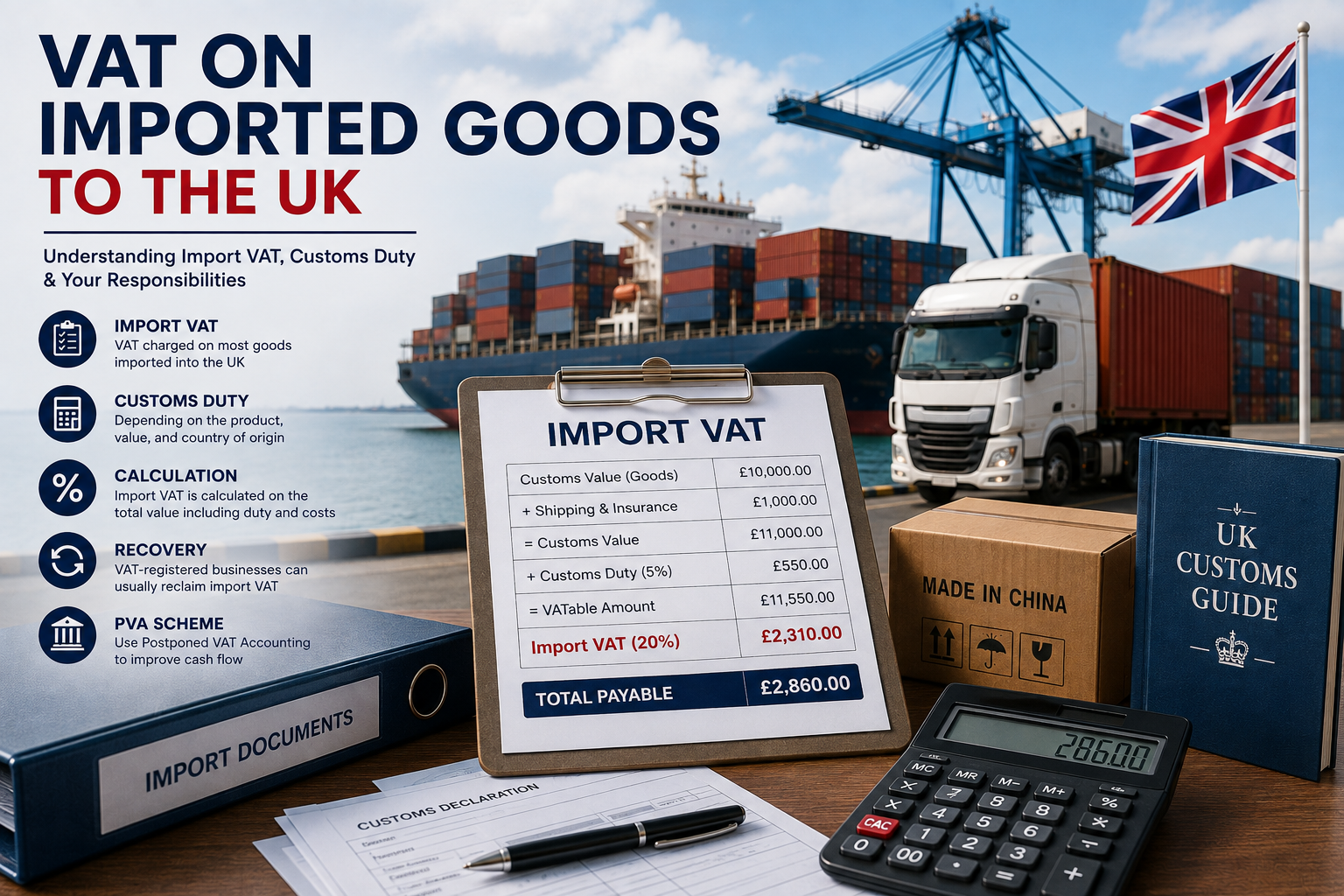
Customs Duty and import VAT are different charges.
Customs Duty is determined using customs rules relating to factors such as:
Import VAT is calculated separately using the relevant VAT valuation rules.
The VAT value can include the customs value together with certain additional costs and applicable duties.
This means Customs Duty itself can potentially affect the amount on which import VAT is calculated.
Consider a simplified hypothetical shipment with a customs value of:
£10,000
Assume the applicable Customs Duty rate is 5%.
Customs Duty would be:
£10,000 × 5% = £500
The £500 Customs Duty may then form part of the value used when calculating import VAT, together with other amounts required under the VAT valuation rules.
The actual import VAT calculation depends on the circumstances and applicable VAT treatment.
This example is for illustration only and should not be treated as a current tariff quotation.
Customs Duty should not be confused with recoverable VAT.
Businesses generally cannot simply reclaim Customs Duty through their VAT return in the way eligible import VAT may potentially be recovered.
For many businesses, Customs Duty therefore forms part of the actual cost of importing their products.
This makes the duty rate particularly important when calculating product margins.
A VAT-registered business may potentially recover eligible import VAT, subject to the normal VAT rules and appropriate evidence.
This makes the distinction between Customs Duty and import VAT particularly important.
Consider them separately when calculating your importing costs and cash-flow requirements.
Customs Duty is only one part of the cost of importing goods.
Depending on your shipment, you may also encounter:
Looking only at Customs Duty can therefore underestimate the true cost of importing.
The landed cost represents the overall cost of getting imported goods to their intended destination.
A simplified landed-cost model is:
Product Cost + Freight + Insurance + Customs Duty + Clearance + Handling + Other Import Costs = Landed Cost
Import VAT should also be considered for cash-flow purposes and as a cost where it is not recoverable.
Calculating landed cost before ordering goods allows businesses to estimate their actual profit margin more accurately.
Suppose a business purchases stock overseas.
The supplier quotation may look highly profitable when compared with the expected UK selling price.
But the business then needs to add:
Supplier Cost
↓
International Freight
↓
Insurance
↓
Customs Duty
↓
Import VAT
↓
Customs Clearance
↓
UK Delivery
↓
Warehouse
Only after considering these costs can the importer properly understand what the goods actually cost to bring into the business.
Yes. Some products may have a zero Customs Duty rate.
Other products may qualify for reduced or zero tariffs because of:
However, zero Customs Duty does not necessarily mean there are no import charges.
Import VAT and other costs may still apply.
Yes.
Tariffs, trade agreements, quotas, trade remedies and customs rules can change.
This is why importers should check the current UK Trade Tariff before arranging a shipment rather than relying on an old article, supplier quotation or previous import.
The principles in this guide remain useful, but the exact rate should always be checked when importing.
Businesses frequently search for a UK import duty calculator to estimate customs charges.
While calculators can be useful for initial budgeting, their result is only as accurate as the information entered.
You still need to establish:
A calculator cannot compensate for an incorrectly classified product.
Responsibility for Customs Duty depends on the importing arrangements.
The importer and the parties involved in the transaction should understand who is responsible for:
The agreed Incoterms can play an important role in allocating costs, responsibilities and risks between buyer and seller.
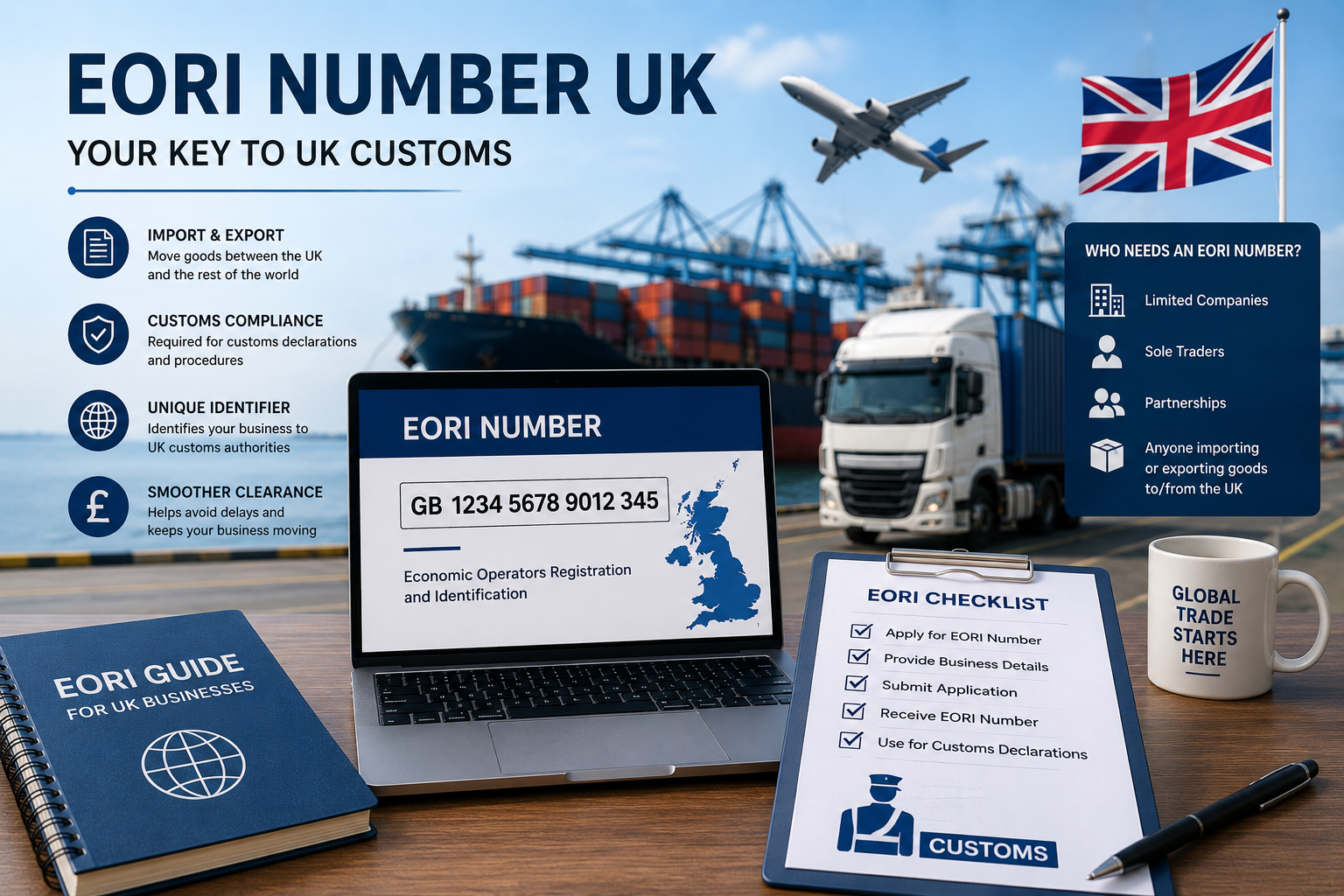
Businesses carrying out customs activities may need an EORI number.
The appropriate EORI requirements depend on the business, its location and the customs activities being performed.
If you intend to import commercially into the UK, establish your EORI requirements before arranging your first shipment.
A customs agent, freight forwarder or courier can often assist with customs declarations and import calculations.
They may help with:
However, the importer should still make sure the information supplied about the goods is accurate.
Businesses should never undervalue goods or deliberately use an incorrect commodity code to reduce Customs Duty.
There are, however, legitimate customs arrangements that may reduce or defer duty in appropriate circumstances.
Depending on eligibility, these can include:
The correct option depends on the goods and what the business intends to do with them.
Importers should avoid mistakes such as:
Small percentage differences can become significant when importing high-value or high-volume shipments.
Before purchasing products from an overseas supplier, follow this process:
Step 1: Identify exactly what you are importing.
Step 2: Find the appropriate UK commodity code.
Step 3: Establish the country of origin.
Step 4: Determine the appropriate customs value.
Step 5: Check the current UK Trade Tariff.
Step 6: Identify any preferential tariffs or additional measures.
Step 7: Calculate estimated Customs Duty.
Step 8: Estimate import VAT.
Step 9: Add freight, clearance and other import costs.
Step 10: Calculate your total landed cost.
This gives you a much more realistic picture of the economics of your shipment.
There is no single UK import duty percentage. The amount depends on the goods, commodity code, customs value, origin and applicable tariff treatment.
Where a percentage-based duty applies, a simplified calculation is:
Customs Value × Applicable Duty Rate = Customs Duty
Other tariff calculation methods may apply to particular goods.
No. Import VAT and Customs Duty are separate charges.
Transport and related costs can affect customs valuation depending on the circumstances and applicable valuation rules. Importers should establish the correct customs value rather than simply using the supplier's product price.
Not necessarily. Some goods may have a zero duty rate or qualify for preferential treatment or relief. Other import charges may still apply.
Identify the correct commodity code and check the current UK Trade Tariff for the goods and their origin.
Customs Duty is not normally recovered through a VAT return. Specific repayment or relief procedures may exist where duty has been overpaid or particular customs conditions are satisfied.
Before importing goods, check:
So, how much import duty will you pay in the UK?
There is no universal answer.
Your Customs Duty will depend primarily on what you are importing, its commodity code, customs value, origin and the tariff measures applicable when the goods are imported.
The safest approach is to work through the calculation in order:
Product → Commodity Code → Origin → Customs Value → Duty Rate → Customs Duty → Import VAT → Other Costs → Landed Cost
Most importantly, check the current UK Trade Tariff on GOV.UK before committing to a shipment.
Import duty can directly affect your product margin, so understanding the complete landed cost before placing an overseas order can help prevent expensive surprises when the goods reach the UK.
This article provides general information only and should not be treated as customs, tax, accounting or legal advice. Import requirements and tariff rates can change, and the correct treatment depends on the particular goods and circumstances.