By

August 10, 2026
How Do I Import Goods Into the UK?
Importing goods into the UK can open up new suppliers, products and markets for your business. Whether you are buying products from China, the European Union, the United States or elsewhere, there are several customs, tax and compliance requirements you need to understand before your goods arrive.
The exact process depends on the goods, their value, country of origin, how they are transported and whether any special licences or controls apply.
This guide explains the main steps involved in importing goods into the UK.
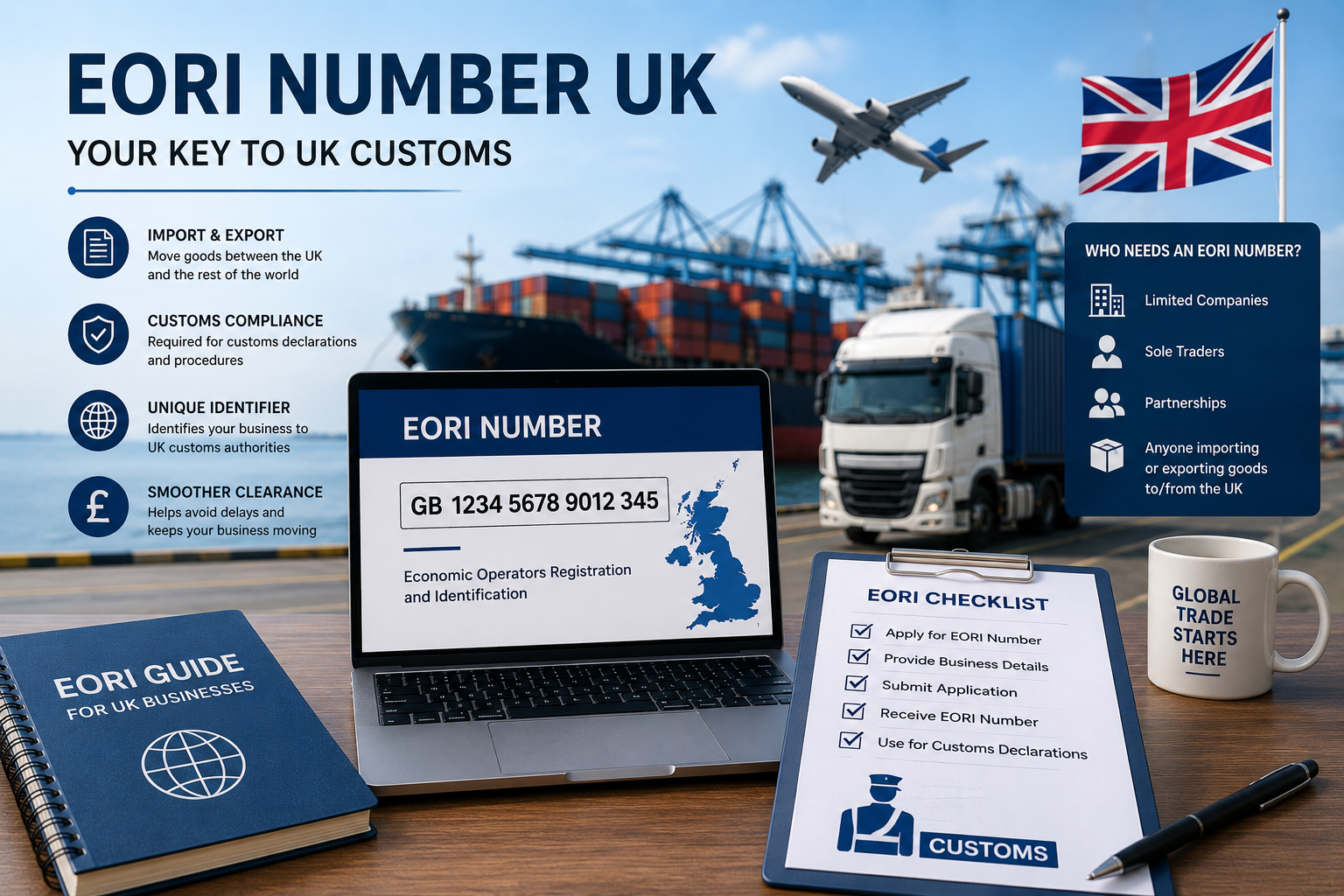
Many businesses importing goods into Great Britain will need an Economic Operators Registration and Identification (EORI) number.
An EORI number is used to identify your business when dealing with customs.
UK businesses commonly need an EORI number beginning with GB when moving goods into or out of Great Britain.
Before arranging your first shipment, check whether you need an EORI number and apply through GOV.UK where required.
Before purchasing products from an overseas supplier, check whether the goods can legally be imported into the UK.
Some products are prohibited, restricted or subject to additional controls.
Depending on the product, you may need:
Products such as food, plants, animals, medicines, chemicals and certain controlled goods can have additional requirements.
Imported products need to be classified using the appropriate commodity code.
The commodity code is extremely important because it can determine:
You can search for commodity codes using the UK Trade Tariff on GOV.UK.
Incorrectly classifying goods can result in the wrong amount of tax being paid or cause problems during customs clearance.
The country of origin is not necessarily the same as the country from which the goods are shipped.
For customs purposes, origin generally relates to where goods were produced or underwent sufficient manufacturing or processing.
This matters because the UK has trade agreements with various countries that may provide preferential tariff treatment for qualifying goods.
You may need evidence demonstrating that the products meet the relevant rules of origin before claiming a preferential rate of customs duty.
Depending on the type and origin of the goods, customs duty may be payable when products enter the UK.
The applicable rate depends largely on the product's commodity code and origin.
Customs value can include more than simply the supplier's invoice price. Depending on the circumstances, costs such as transportation and insurance may also affect the customs value.
Before placing a large overseas order, calculate the potential customs duty so that it can be included in your product's total landed cost.
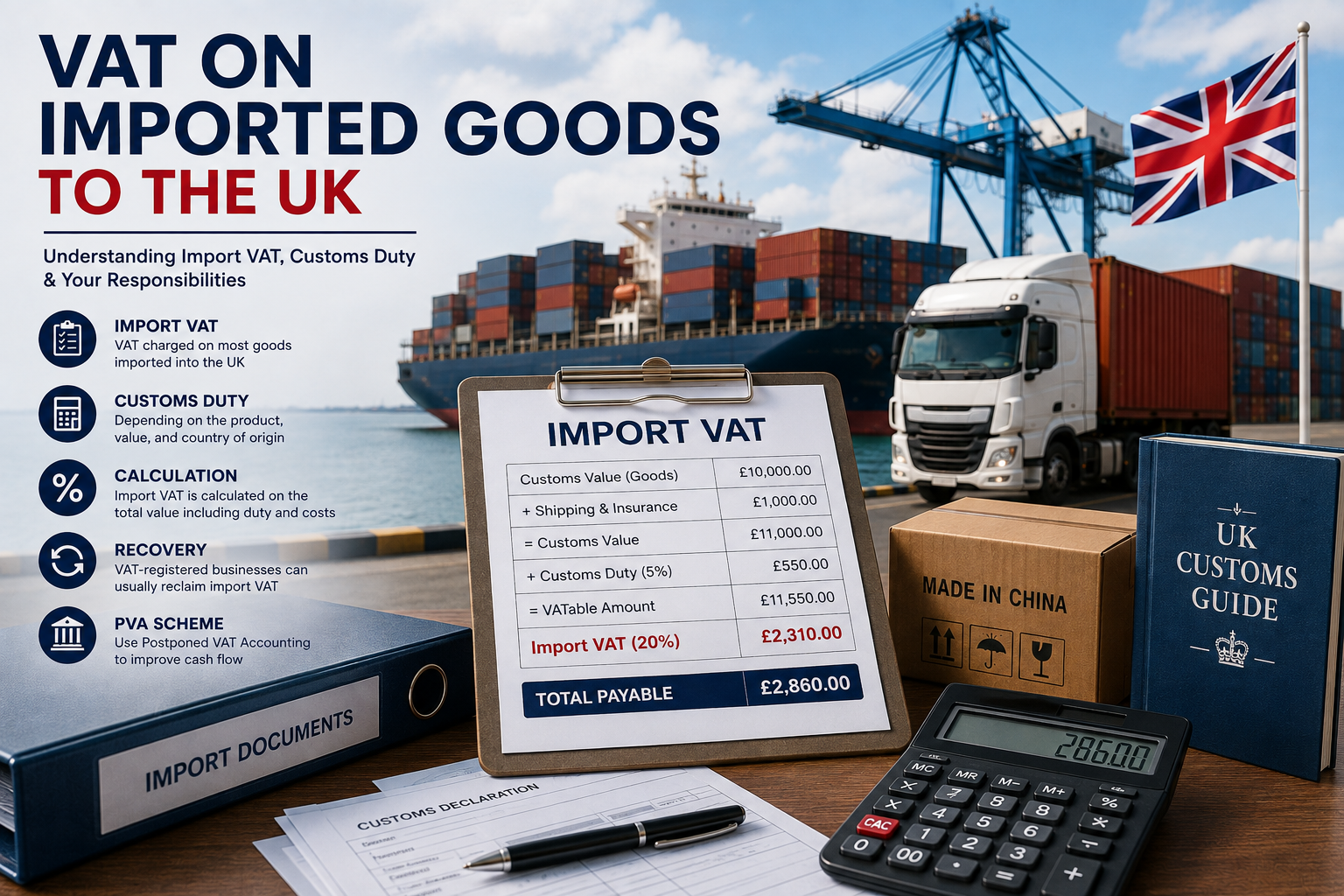
Import VAT may also be payable when goods are imported into the UK.
Import VAT and customs duty are different charges.
For VAT-registered businesses, there may be mechanisms for accounting for import VAT through the VAT return, such as Postponed VAT Accounting, where the relevant conditions are satisfied.
Whether import VAT can ultimately be recovered depends on the circumstances and applicable VAT rules.
Before agreeing to buy goods from an overseas supplier, establish which Incoterm applies to the transaction.
Common Incoterms include:
Incoterms determine important responsibilities between the buyer and seller, including transportation, risk and certain customs responsibilities.
For example, a quotation that appears inexpensive under EXW terms may leave the UK buyer responsible for considerably more transportation and export-related costs than initially expected.
Understanding the agreed Incoterm is therefore essential when comparing supplier quotations.
You will need to decide how your goods will be transported to the UK.
Common options include:
Air freight – generally faster but often more expensive.
Sea freight – commonly used for larger commercial shipments and containers.
Road freight – particularly relevant for goods moving between the UK and continental Europe.
Courier services – often convenient for smaller parcels and samples.
The best option depends on the size, weight, value and urgency of your shipment.
A freight forwarder can arrange transportation and coordinate different parts of the international shipping process.
Depending on the services provided, a freight forwarder may assist with:
For businesses importing regularly, a reliable freight forwarder can simplify international logistics considerably.
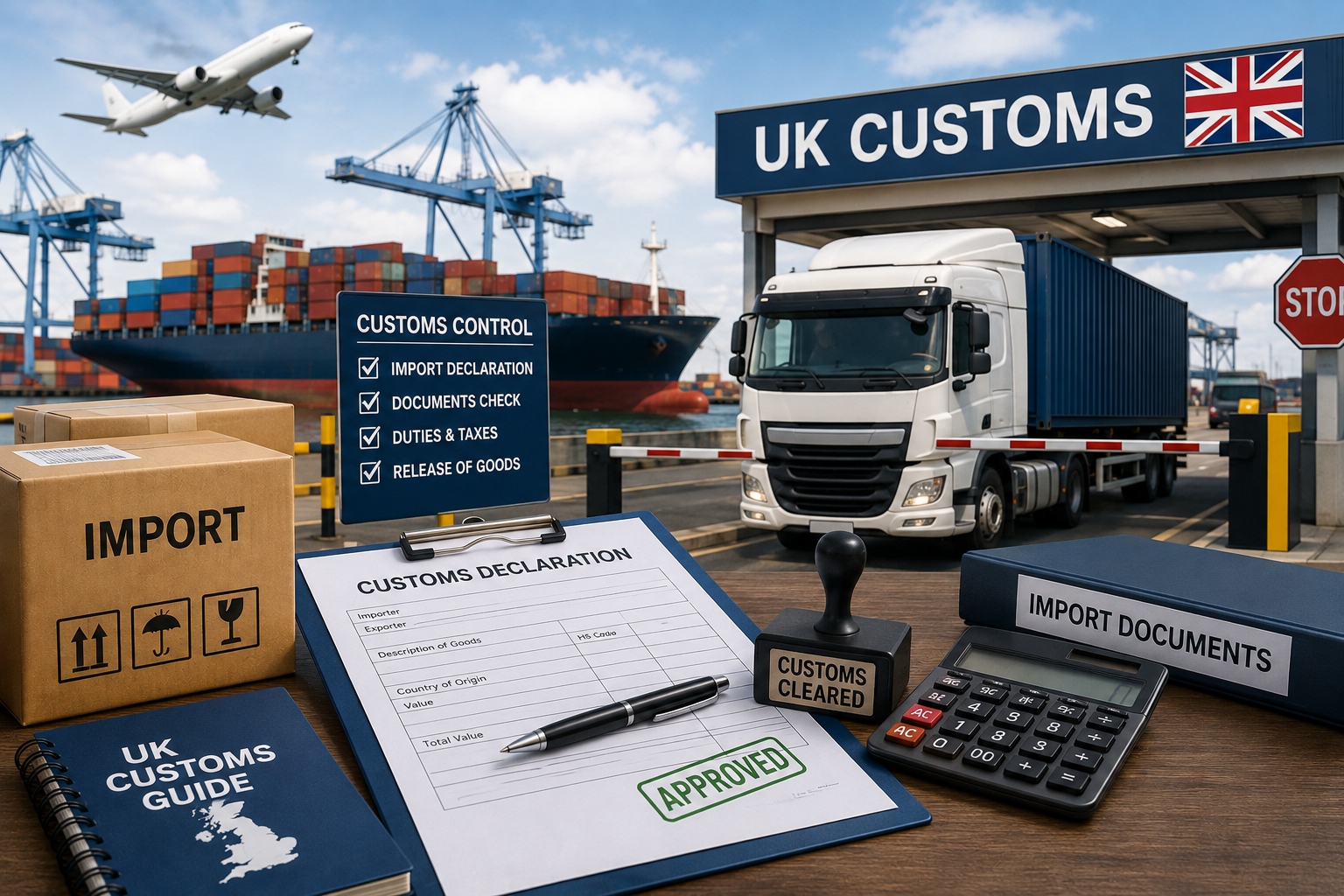
Imported goods generally need to be declared to UK customs.
The declaration includes information such as:
Many businesses use a customs agent, freight forwarder or courier to make customs declarations on their behalf.
However, the importer should still ensure that the information supplied is accurate.
The exact documents required depend on the goods and transaction, but commonly used import documentation includes:
Maintaining accurate documentation can make customs clearance significantly easier.
When your shipment arrives, it must complete the appropriate customs procedures before being released.
Your customs agent or carrier may submit the declaration and arrange payment or accounting of applicable charges.
Customs may also request additional documentation or inspect a shipment.
Once the required procedures have been completed, the goods can normally be released for delivery.
Customs clearance is not the only consideration.
Goods sold in the UK must also comply with applicable UK product safety, labelling and regulatory requirements.
Depending on what you import, requirements may cover:
As the importer, your business can have important legal responsibilities for ensuring products placed on the UK market comply with applicable requirements.
Never assume that a product is compliant simply because the overseas manufacturer already sells it in another country.
One of the most important calculations for an importer is the landed cost.
The purchase price is only part of the real cost of importing a product.
Your landed cost may include:
Product cost + overseas transport + international freight + insurance + customs duty + customs clearance + port or handling fees + UK delivery + other applicable charges
Import VAT should also be considered from a cash-flow perspective, although its ultimate cost depends on whether and how it can be recovered.
Calculating landed cost before ordering helps determine whether importing a product is actually profitable.
Imagine a UK company purchases products from a manufacturer in China.
The company would typically need to establish:
The company might then appoint a freight forwarder and customs agent to arrange transportation and customs clearance.
Yes. A UK limited company can import goods for its business.
The company may need an EORI number and must comply with the relevant customs, tax, product and record-keeping requirements.
Being registered at Companies House does not, by itself, complete the customs registrations or approvals required for importing.
A business does not necessarily need to be VAT registered simply because it imports goods.
However, import VAT can still arise.
A business that is not VAT registered will generally not have the same ability to recover import VAT through a VAT return, which can make VAT an important part of the product's overall cost.
China is a major source of products for UK importers.
When importing from China, pay particular attention to:
The cheapest supplier quotation does not necessarily produce the lowest landed cost.
Goods entering Great Britain from the EU are also subject to customs procedures.
Some goods of qualifying origin may benefit from preferential tariff treatment under the UK-EU trading arrangements, but eligibility depends on the relevant rules of origin.
Simply purchasing goods from an EU supplier does not necessarily mean that the products are of EU origin.
Businesses should retain appropriate records relating to their imports.
These may include:
Accurate records are important for customs, VAT, accounting and product compliance purposes.
A simple starting process is:
Choose the product → verify the supplier → check product regulations → obtain an EORI number if required → find the commodity code → check origin and duty → calculate import VAT → agree Incoterms → arrange freight → submit the customs declaration → clear the goods → deliver them to your business.
For new importers, completing these checks before paying an overseas supplier can prevent expensive surprises when the shipment reaches the UK.
Customs procedures, tariffs, trade agreements and product regulations can change.
Always check the latest official guidance on GOV.UK, including the UK Trade Tariff and HMRC customs guidance, before importing goods.
For complex or high-value shipments, consider obtaining advice from a qualified customs specialist, freight forwarder, customs agent or tax adviser.
This article is for general information only and does not constitute customs, tax or legal advice. Import requirements depend on the goods, origin, destination and circumstances of each transaction.