By

October 8, 2026
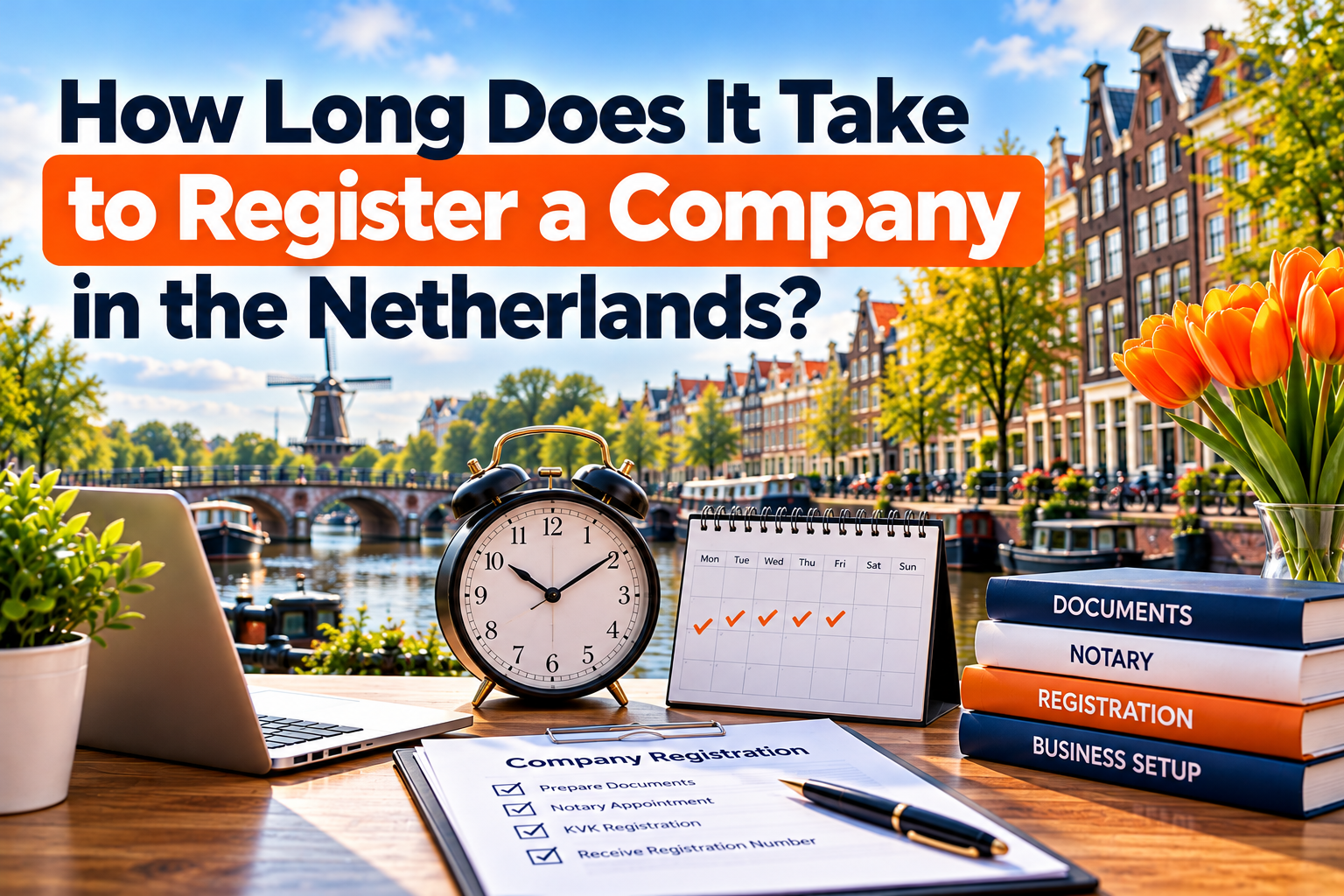
How Long Does It Take to Register a Company in the Netherlands?
The Netherlands is a popular destination for foreign entrepreneurs, international investors, and businesses looking to expand into Europe. With its efficient registration system and established corporate framework, setting up a company in the Netherlands can be relatively straightforward.
But how long does it take to register a company in the Netherlands?
A straightforward Dutch private limited company (BV) can often be incorporated within a few working days once all required documents have been approved. However, the complete process may take approximately 1 to 3 weeks or longer, depending on the company structure, notary availability, documentation, and verification requirements.
This guide explains the Netherlands company registration timeline, the main incorporation steps, and how foreign entrepreneurs can avoid unnecessary delays.
A Dutch BV, officially known as a Besloten Vennootschap, is one of the most common business structures for foreign entrepreneurs.
The incorporation process involves preparing corporate documents, verifying shareholders and directors, executing the incorporation deed, and registering the company with the Dutch Chamber of Commerce (KVK).
Once the notary has approved the documentation, incorporation can often be completed within a few working days.
However, the overall timeline depends on how quickly the required information is submitted and verified.
Step 1: Choose the Company Structure
Select the appropriate business structure, such as a Dutch BV, branch, or subsidiary.
This initial stage can usually be completed quickly once the business objectives and ownership arrangements are clear.
Step 2: Prepare the Required Documents
Gather identification documents, shareholder and director details, proposed company name, business activities, and registered address information.
Foreign corporate shareholders may need additional documents, translations, or legalisation.
Step 3: Arrange a Dutch Business Address
A qualifying Dutch business address is generally required for company registration.
Arranging suitable premises or an eligible business address service may affect the incorporation timeline.
Step 4: Complete Notarial Incorporation
A Dutch civil-law notary prepares and executes the incorporation deed and articles of association for a BV.
The notary must complete the necessary identity and compliance checks before incorporation.
Step 5: Register With the Chamber of Commerce
The company is registered with the Dutch Chamber of Commerce (KVK), which issues its official registration number.
For a Dutch BV, the notary normally handles this registration.
Step 6: Complete Tax Registration and Banking
Following incorporation, the company must meet applicable tax registration requirements and arrange suitable business banking services.
Bank account approval is a separate process and may take longer than the legal incorporation itself.
Yes. Foreign entrepreneurs can generally establish and own a Dutch company without being residents of the Netherlands.
However, the registration process may take longer where overseas shareholders, foreign corporate documents, or additional identification checks are involved.
Factors that can cause delays include:
Preparing the necessary documents in advance can help accelerate the incorporation process.
In certain circumstances, foreign entrepreneurs can establish a Dutch BV without physically travelling to the Netherlands.
Remote incorporation may be possible through a Dutch civil-law notary, subject to applicable identity verification and legal requirements.
The timeline depends on the notary's procedures, documentation, and whether additional authorisations or representation arrangements are necessary.
Remote company formation does not automatically guarantee faster registration.
Opening a business account is often one of the more time-consuming stages of establishing an operational Dutch company.
Banks and financial institutions normally review company registration documents, shareholder identification, beneficial ownership information, and expected business activities.
Foreign-owned companies may face additional compliance checks.
Banking arrangements can take several working days or multiple weeks, depending on the provider and complexity of the application.
Importantly, a Dutch company can be legally incorporated before its business bank account is fully operational.
Entrepreneurs can reduce avoidable delays by preparing their incorporation requirements before starting the process.
Recommended steps include:
A well-prepared application can help make the registration process more efficient.
A Dutch BV generally acquires legal personality when its notarial incorporation deed is executed.
However, businesses should ensure that required registrations, tax arrangements, licences, and other operational requirements are completed before commencing relevant activities.
Certain regulated businesses may need additional approvals before they can legally operate.
The date of incorporation and the date when the business becomes fully operational may therefore differ.
In some straightforward cases, notarial incorporation may be completed very quickly once all documents and checks are finalised. However, same-day completion of the entire registration process cannot be guaranteed.
A straightforward Dutch BV formation may take approximately 1 to 3 weeks from initial preparation, although complex applications can take longer.
Not necessarily. Remote incorporation may be possible through a Dutch civil-law notary, depending on the circumstances.
A business bank account is not generally required before executing the incorporation deed of a Dutch BV. However, banking arrangements are important for normal business operations.
A company may generally begin lawful business activities once incorporated and the applicable registration, licensing, tax, and operational requirements have been satisfied.
Registering a company in the Netherlands involves several important legal and administrative procedures.
For foreign entrepreneurs, coordinating documentation, notarial incorporation, business registration, and compliance requirements from overseas can be challenging.
Professional company formation assistance can help streamline the process, reduce administrative complications, and ensure that the necessary incorporation steps are properly coordinated.
Are you planning to register a Dutch BV, establish a company in the Netherlands as a foreigner, or expand your existing business into Europe?
Our Netherlands company formation services can help guide you through the registration process, including document preparation, incorporation formalities, business registration, and compliance requirements.
Contact us today to discuss your Netherlands company registration requirements and request a personalised quotation.
Start your Dutch company formation process with professional guidance and a clear understanding of the expected timeline.