By

October 8, 2026
How Long Does It Take to Open a Business Bank Account for an Estonian Company?
Estonia has become an attractive destination for international entrepreneurs looking to establish a European business. Its advanced digital infrastructure, efficient company registration system, and access to the European Union make it particularly appealing to startups, consultants, online businesses, and foreign investors.
However, once a company has been registered, one of the most important practical questions is: How long does it take to open a business bank account for an Estonian company?
The answer depends on several factors, including the financial institution, the company's ownership structure, the residency of its directors, and the complexity of its business activities.
Some straightforward applications may be completed within a few working days, while others can take several weeks or longer, particularly where additional compliance checks are required.
Newly registered companies and businesses managed by non-resident directors may also face different onboarding procedures.
This comprehensive guide explains how long business account opening can take in Estonia, what influences the approval process, which documents are required, and how entrepreneurs can reduce unnecessary delays.
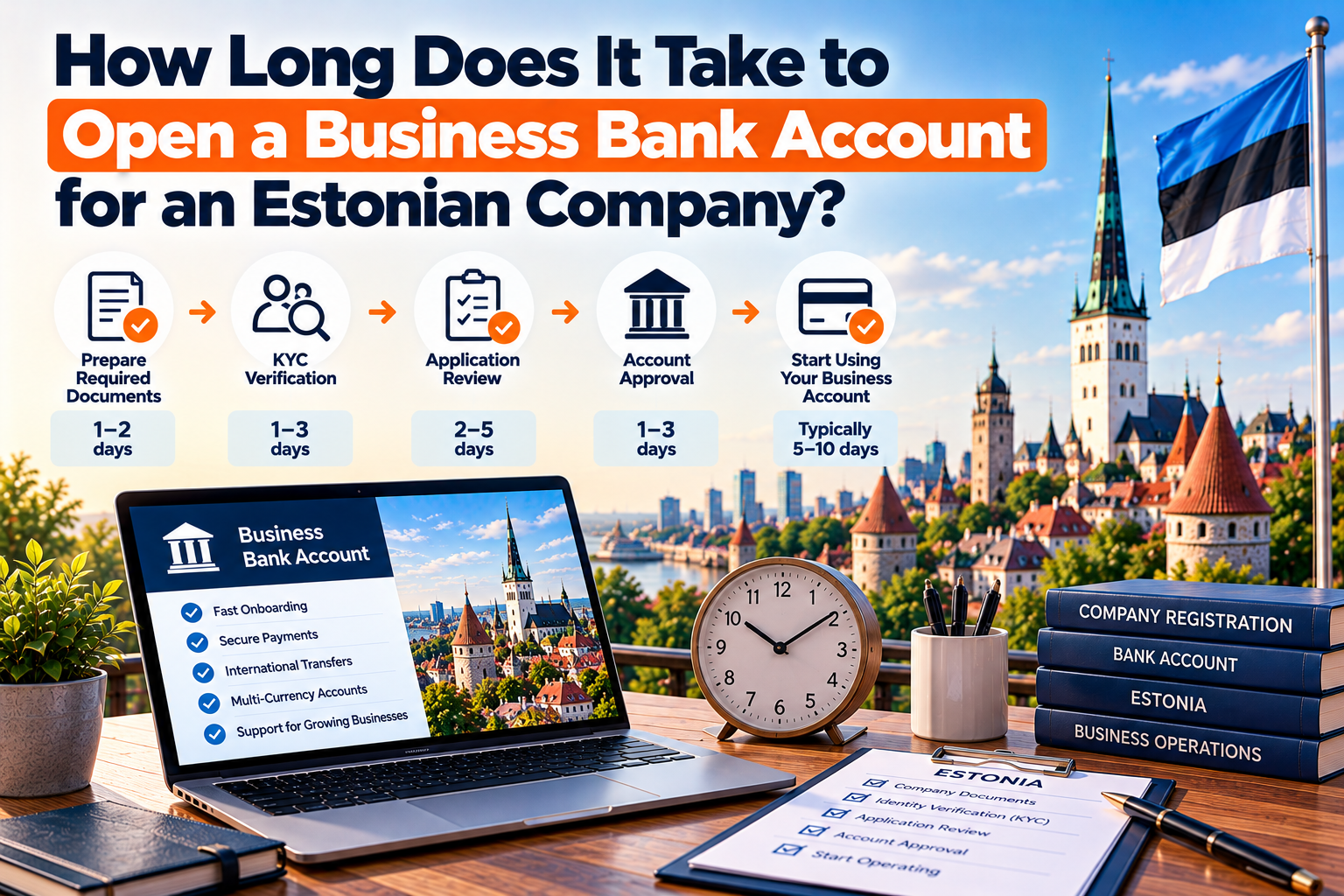
There is no universal processing time for opening a business bank account in Estonia.
Each financial institution has its own onboarding procedures, customer eligibility criteria, and compliance requirements.
For a straightforward application involving a company with a simple ownership structure, complete documentation, and clearly defined business activities, the process may take several working days.
Other applications may require one or more weeks, particularly where the institution requests additional information.
Companies with complex ownership structures, international operations, or non-resident directors may experience longer processing times.
It is important to distinguish between submitting an account application, completing identity verification, receiving approval, and obtaining an active account that can send and receive payments.
An account application is not considered complete simply because an online form has been submitted. The financial institution must finish its required verification procedures before the account can become operational.
In certain circumstances, an eligible business may complete an account application and verification process quickly.
However, same-day approval should not be assumed.
Traditional banks may need additional time to assess the company's ownership structure, business activities, and economic connections to Estonia.
Even when an application is submitted electronically, the institution may conduct manual reviews or request further documentation.
Some regulated financial service providers offer streamlined digital onboarding, but approval remains subject to their compliance requirements.
Entrepreneurs should therefore avoid making urgent payment commitments based on the assumption that an account will be available immediately.
A newly incorporated Estonian company can generally apply for business banking services once its registration has been completed.
There is no universal requirement for the company to operate for several months before applying.
However, because a new business may not have previous financial statements, transaction records, or customer invoices, the institution may request information about its intended activities.
This can include details of expected customers, anticipated monthly turnover, initial funding, and the countries where payments will originate.
A newly registered company with clear commercial activities and complete documentation may progress through onboarding more efficiently than one whose intended operations are difficult to verify.
The age of the company is therefore only one consideration.
The quality and completeness of the application can be equally important.
It can.
Foreign-owned Estonian companies may be subject to additional verification procedures, depending on the financial institution and the circumstances of the business.
Some traditional banks place particular importance on a company's economic connection to Estonia.
For example, they may request evidence of Estonian customers, suppliers, employees, commercial contracts, or other business activities.
Where the company's directors and beneficial owners live outside Estonia, the institution may also need to verify identification documents issued in other jurisdictions.
Additional checks may be required concerning the ownership structure, source of funds, and intended international transactions.
However, foreign ownership does not automatically mean that an application will take longer.
A foreign-owned company with a straightforward ownership structure and clear business activities may still complete onboarding efficiently.
Some financial institutions support remote business account applications.
This can be particularly convenient for foreign entrepreneurs who manage Estonian companies from another country.
A remote application may involve completing an online form, submitting company documents, uploading identification records, and completing electronic identity verification.
However, remote onboarding is not universally available.
Some traditional banks may require directors or authorised representatives to attend an in-person identification appointment.
Where an appointment is necessary, the time required to arrange travel or secure an available appointment can extend the overall account-opening process.
Entrepreneurs should confirm whether the entire onboarding procedure can be completed remotely before submitting an application.
Several factors can influence how quickly an Estonian company receives approval.
A company with one shareholder and a straightforward management structure may be easier to verify than a business owned through several corporate entities.
Complex structures may require additional documentation to identify the individuals who ultimately own or control the company.
Financial institutions may need to complete additional verification procedures for directors and beneficial owners residing outside Estonia.
The extent of these checks depends on the institution's policies and the jurisdictions involved.
Some business activities require more detailed compliance assessments.
Companies involved in international trading, financial services, or other regulated activities may need to provide additional explanations or supporting documentation.
Financial institutions assess the geographical markets where the company expects to operate.
Transactions involving certain jurisdictions may require enhanced due diligence or may fall outside the institution's accepted risk profile.
The institution may request information about the origin of the company's initial capital and future incoming payments.
Incomplete or unclear explanations can delay approval.
Missing identification documents, inconsistent company information, or incomplete application forms are common causes of delays.
Submitting accurate information from the beginning can help reduce additional enquiries.
Financial institutions apply their own onboarding and risk assessment processes.
Some applications may be reviewed automatically, while others require manual assessment.
Where in-person verification is required, appointment availability may affect the overall timeline.
Preparing documentation before applying can help avoid unnecessary delays.
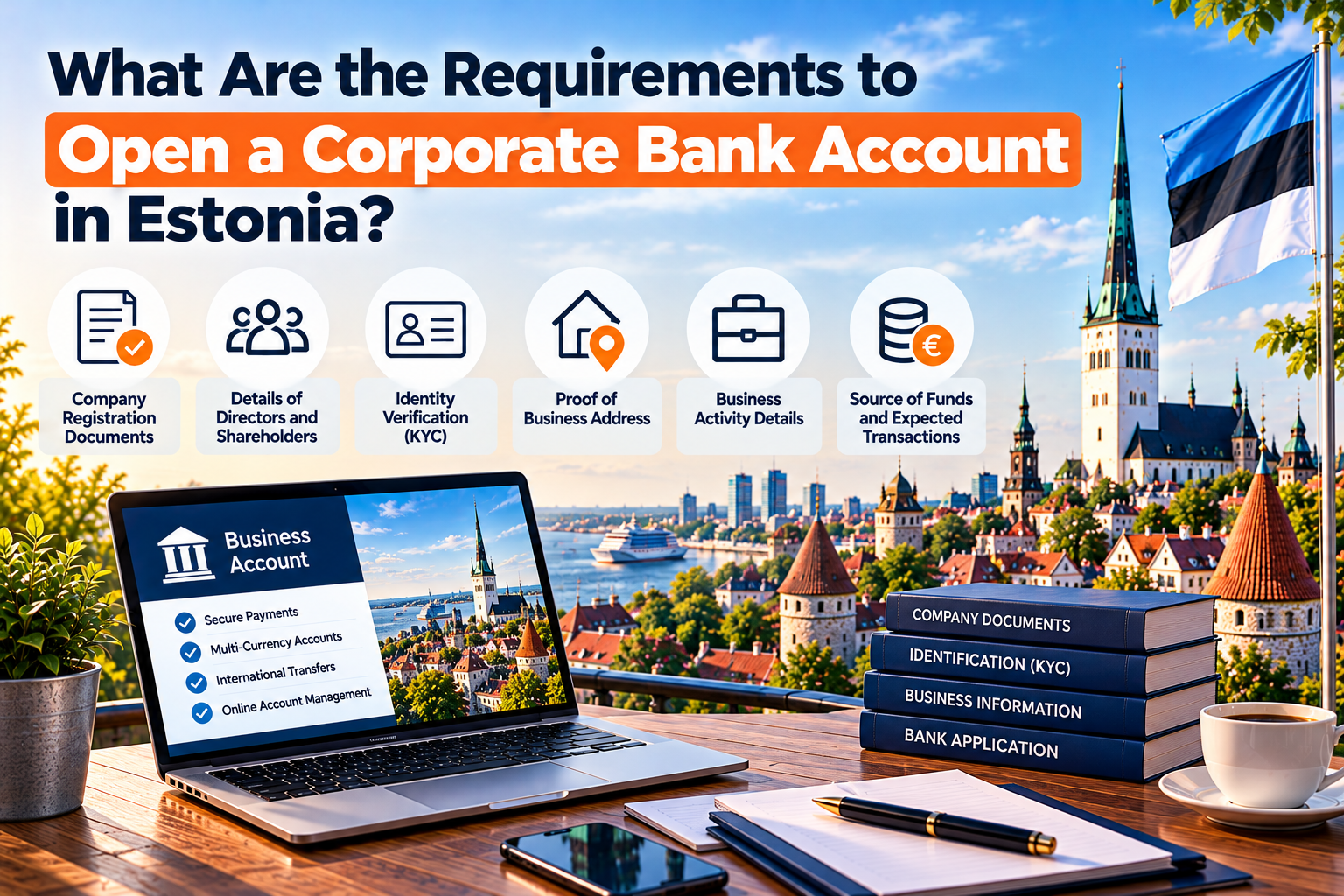
Although requirements differ between institutions, companies should generally have the following information available.
The company's legal name, registration number, registered address, and incorporation details must be verifiable through the Estonian Commercial Register.
The financial institution may request the company's articles of association to confirm its governance and representation arrangements.
Directors, authorised representatives, and beneficial owners may need to provide valid passports or national identity documents.
Relevant individuals may need to submit recent address verification documents.
The institution must identify the individuals who ultimately own or control the business.
Complex ownership structures may require supporting corporate documentation.
The company should clearly explain the products or services it provides, its intended customers, and the markets in which it operates.
Applicants may need to provide estimated monthly turnover, transaction frequency, average payment amounts, currencies, and countries involved.
The institution may request an explanation of the company's initial financing and the expected origin of incoming payments.
Preparing this information in advance can make the verification process more efficient.
Compliance verification is one of the most important stages of opening a business bank account.
Financial institutions must comply with applicable anti-money laundering and counter-terrorist financing requirements.
These obligations include identifying customers, verifying beneficial ownership, understanding the purpose of the business relationship, and assessing relevant risks.
The time required depends on the complexity of the application.
A company with simple ownership and clearly documented activities may require fewer additional checks.
A company with multiple corporate shareholders, international operations, or unusual transaction arrangements may require a more detailed review.
There is no universal deadline by which every institution must complete an individual onboarding assessment.
Companies should therefore allow sufficient time for verification and respond promptly to requests for additional information.
Estonian e-Residency can simplify certain digital identification and company administration procedures.
It allows eligible individuals to access supported Estonian electronic services and sign documents digitally.
However, e-Residency does not guarantee faster business bank account approval.
Financial institutions must still conduct their own customer identification and compliance assessments.
Some may support e-Residency-based identification procedures, while others may require additional verification.
Holding an e-Residency card does not automatically establish a commercial connection to Estonia or satisfy every institution's onboarding requirements.
E-Residency is therefore useful for digital administration, but it should not be treated as a substitute for financial compliance procedures.
Yes.
A newly registered Estonian company does not necessarily need previous sales, customer invoices, or financial statements to apply for a business account.
Financial institutions recognise that businesses often need payment facilities before beginning commercial operations.
Instead of reviewing historical transactions, the institution may assess the company's planned activities and expected payment requirements.
For example, a newly established consulting company may explain that it intends to receive monthly payments from business clients in Europe.
An online retailer may describe its expected customer markets, products, and anticipated payment volumes.
Clear and realistic explanations can help the institution understand how the account will be used.
However, the absence of trading history does not remove the requirement to complete identity and compliance checks.
A regulated corporate e-money account may offer a different onboarding process from a traditional business bank account.
Some electronic money institutions provide digital application procedures that can be convenient for companies operating internationally.
Depending on the provider and the complexity of the application, onboarding may be relatively efficient.
However, e-money accounts are not automatically approved more quickly than traditional bank accounts.
Electronic money institutions must also comply with applicable identity verification, anti-money laundering, and customer due diligence requirements.
The actual processing time depends on the company's circumstances and the provider's procedures.
It is also important to understand the difference between the two account types.
Traditional business bank accounts are provided by licensed credit institutions.
Corporate e-money accounts are provided by regulated electronic money institutions and are designed primarily for electronic money and payment services.
Depending on the provider, an e-money account may support EU IBAN facilities, SEPA transfers, international payments, and currency conversion.
E-money balances are not traditional bank deposits and are subject to different regulatory protections.
For companies primarily requiring payment services, a suitable regulated e-money account may be an alternative worth considering.
The time required to obtain an EU IBAN depends on the financial institution providing the account.
An IBAN is an account identifier used for payment transactions.
It may be associated with a traditional bank account or a regulated payment or e-money account.
Some providers issue account details after completing the required verification and approval procedures.
Others may require additional activation steps before the account can receive or send payments.
Companies should confirm when the IBAN will become available and whether all required payment services will be active immediately.
An IBAN being issued does not necessarily mean every payment feature has already been enabled.
Yes. An Estonian company may use an eligible business payment account with an IBAN issued in another European country.
The account does not generally need to have an Estonian IBAN simply because the company is incorporated in Estonia.
Under applicable SEPA rules, covered euro credit transfers and direct debits are subject to protections against certain forms of IBAN discrimination.
This means that eligible payment accounts in other EU member states may be suitable for Estonian businesses.
However, the account must support the company's required payment methods, currencies, and transaction activity.
Considering suitable financial institutions outside Estonia may provide additional options for internationally managed businesses.
Although financial institutions control their own approval procedures, entrepreneurs can take several steps to reduce avoidable delays.
Gather the company registration details, identification documents, ownership information, and supporting records in advance.
Ensure that the company name, registration number, shareholder details, and other application information are consistent.
Describe the company's products or services, customer base, and expected commercial operations.
Avoid vague descriptions that make it difficult for the institution to understand the business.
Provide realistic estimates of monthly turnover, payment frequency, transaction amounts, and countries involved.
Be prepared to describe how the company will finance its operations and where incoming payments are expected to originate.
Check whether the institution accepts the company's ownership structure, director residency, and business activities.
Where appropriate, selecting an institution that supports remote verification may reduce delays associated with travel or appointments.
If additional information is requested, provide complete and accurate responses as quickly as possible.
These measures cannot guarantee approval, but they can help avoid unnecessary interruptions.
Ensure that the business has been officially incorporated and entered into the Estonian Commercial Register.
Determine whether the company needs a traditional bank account, an EU IBAN payment account, SEPA transfers, international payments, or currency conversion.
Confirm that the institution accepts the company's legal structure, ownership arrangements, business activities, and director residency.
Gather the company registration information, identification documents, beneficial ownership details, and expected transaction information.
Complete the application accurately and provide all requested documentation.
Directors, authorised representatives, and beneficial owners may need to complete electronic or in-person verification procedures.
The institution will review the company's activities, ownership structure, funding sources, and intended transactions.
Once the assessment is complete, the institution will determine whether the company qualifies for the requested services.
After approval, complete any required activation procedures and confirm that the necessary payment services are available.
If an application takes longer than expected, the first step is to determine whether the financial institution requires additional information.
Applicants should review their communications and confirm whether any documentation or verification procedures remain outstanding.
If no further information has been requested, the company may contact the institution to ask about the application status.
It is important to provide consistent and accurate information throughout the process.
Submitting multiple incomplete applications or changing information unnecessarily may create additional complications.
Where an institution cannot provide a suitable account, the company may consider other regulated financial service providers.
However, each new application will remain subject to the relevant eligibility and compliance requirements.
Processing times vary. Some straightforward applications may be completed within a few working days, while others can take several weeks or longer depending on compliance requirements.
A newly registered company can generally apply after incorporation. However, the account will not become operational until the institution completes its approval and verification procedures.
Some applications may progress quickly, but approval within 24 hours is not guaranteed.
It can, particularly where additional identity verification, ownership checks, or economic connection assessments are required.
Some financial institutions support remote onboarding. Others may require an in-person appointment.
E-Residency can simplify certain digital administration procedures, but it does not guarantee faster financial account approval.
Yes. Existing revenue is not universally required, although the company must provide sufficient information about its intended activities and expected transactions.
The timeline depends on the provider and its onboarding procedures. Account details are generally made available after the required approval and activation steps.
Some e-money institutions offer streamlined digital onboarding, but processing times vary and approval is not guaranteed.
Yes. An eligible account with an IBAN issued in another European country may support the company's business payment requirements.
Common factors include incomplete documentation, complex ownership structures, additional compliance checks, unclear business activities, and identity verification requirements.
Prepare complete documentation, explain the company's activities clearly, confirm eligibility before applying, and respond promptly to compliance enquiries.
Opening a business bank account for an Estonian company may take anywhere from a few working days to several weeks or longer, depending on the financial institution and the complexity of the application.
Newly registered companies can generally apply immediately after incorporation, even without existing revenue or trading history.
However, financial institutions must verify the company's legal status, directors, beneficial owners, business activities, and expected transactions before approving an account.
Foreign-owned companies and businesses managed by non-resident directors may face additional checks, particularly where the company has limited economic connections to Estonia.
For businesses primarily requiring euro payments, international transfers, and EU IBAN facilities, regulated corporate payment accounts and e-money accounts may provide alternative solutions.
The most effective approach is to prepare accurate documentation early, understand the institution's eligibility requirements, and allow sufficient time for verification.
By planning ahead and choosing financial services that match their operational requirements, Estonian companies can reduce unnecessary delays and establish the payment infrastructure needed to begin conducting business.