By

October 8, 2026
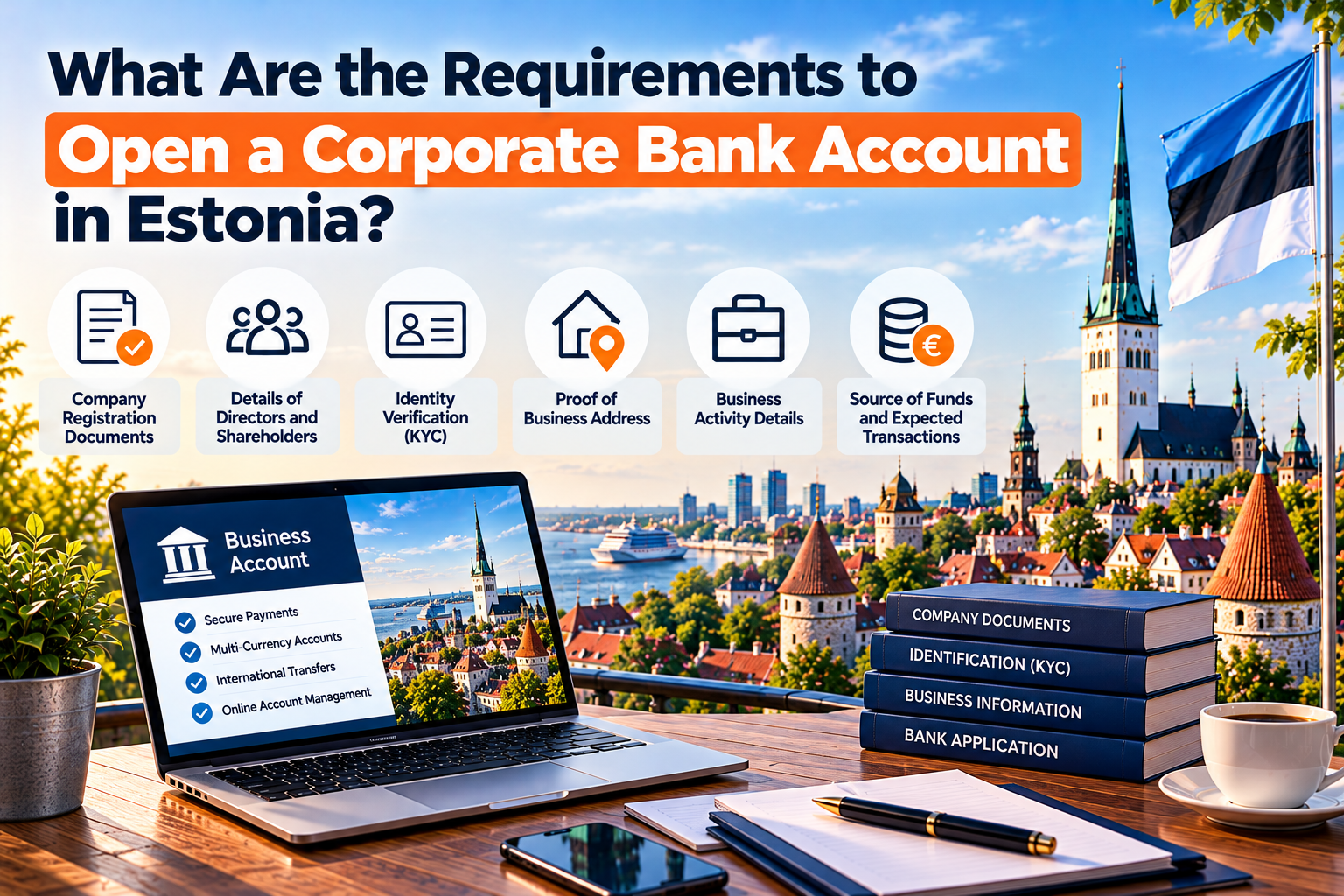
What Are the Requirements to Open a Corporate Bank Account in Estonia?
Estonia has established itself as an attractive European business destination, offering a modern digital infrastructure, efficient company registration procedures, and access to the European Union's single market.
For entrepreneurs establishing a company in Estonia, one of the most important steps after incorporation is arranging suitable business banking facilities.
A corporate bank account allows a company to receive customer payments, pay suppliers, manage operating expenses, and conduct financial transactions.
However, opening a corporate bank account in Estonia involves specific documentation, identity verification, and regulatory compliance requirements. These requirements can vary depending on the financial institution, the company's ownership structure, and its intended business activities.
This comprehensive guide explains the requirements for opening a corporate bank account in Estonia, including the documents needed, eligibility criteria for foreign shareholders, remote application procedures, and alternative EU business payment solutions.
Companies legally registered in Estonia can generally apply for corporate banking services, subject to the eligibility requirements of the chosen financial institution.
The most common business structure used by entrepreneurs is the Estonian private limited company, known as an OÜ (osaühing).
Other legally recognised business entities may also qualify for corporate banking services, depending on their structure and activities.
Financial institutions typically evaluate several factors before accepting an application.
These include the company's legal registration status, the identity of its directors and beneficial owners, its intended business activities, the geographical markets in which it operates, and the expected nature of its financial transactions.
Foreign ownership does not automatically prevent an Estonian company from applying for a corporate bank account.
However, financial institutions may apply additional verification procedures to companies owned or managed by non-residents.
Meeting the basic eligibility requirements allows a company to apply, but does not guarantee account approval.
One of the most important aspects of opening a corporate bank account is preparing the necessary company and identification documents.
Although requirements vary between financial institutions, applicants should generally be ready to provide the following information.
The financial institution must confirm that the company has been legally incorporated.
An official extract from the Estonian Commercial Register can provide essential company information, including its registered name, registration number, legal address, incorporation date, and authorised representatives.
The institution may retrieve this information directly from the register or request supporting documentation.
The company's articles of association may be requested to verify its legal structure, governance arrangements, and representation rules.
These documents help establish how the company is organised and who has authority to act on its behalf.
Company directors and authorised representatives must normally complete identity verification.
This may involve providing a valid passport or national identity card.
Depending on the institution, identification may take place electronically, through video verification, or during an in-person appointment.
Financial institutions must identify and verify the individuals who ultimately own or control the company.
These individuals are commonly referred to as ultimate beneficial owners, or UBOs.
Ownership and control may be established through shareholdings, voting rights, or other arrangements.
Institutions may request shareholder registers, ownership charts, or supporting corporate documents, particularly when the company has several layers of ownership.
Directors, authorised representatives, and beneficial owners may need to provide proof of their residential addresses.
Accepted documents can include utility bills, bank statements, or other recognised address verification records.
Documents may need to be recent and clearly display the relevant individual's name and address.
The financial institution will normally require a clear explanation of what the company does or intends to do.
This should identify the products or services offered, the intended customer base, the principal operating markets, and the purpose of the corporate account.
For newly incorporated companies, a clear explanation of planned activities may be accepted even where the business has not yet generated revenue.
Applicants may need to provide estimates of their expected financial activity.
This can include anticipated monthly turnover, average transaction values, expected incoming and outgoing payments, countries involved in transactions, and currencies used.
For new companies, these estimates should be realistic and consistent with the intended business model.
Financial institutions may ask how the company will finance its initial operations and where money entering the account will originate.
Funding may come from shareholder contributions, commercial revenue, investments, or business loans.
Supporting evidence may be requested where necessary.
Preparing these documents and explanations in advance can help streamline the application process and reduce delays.
An Estonian company must satisfy the applicable legal requirements concerning its registered address and contact information.
However, having a registered address in Estonia does not automatically guarantee access to a corporate bank account.
Some financial institutions may require evidence of a meaningful economic connection to Estonia.
This could include local customers, suppliers, employees, business premises, or other commercial activities.
Companies operating internationally may need to explain why Estonia was selected as their jurisdiction of incorporation and how their business activities are organised.
The requirements depend on the institution's customer acceptance policies.
Yes. Estonian companies with foreign directors or shareholders may apply for corporate banking services.
Estonia's business environment attracts entrepreneurs from different countries, and foreign ownership is permitted under its company formation framework.
However, financial institutions must assess the identities and backgrounds of the individuals who own and control a company.
Additional information may be requested concerning their residency, professional activities, source of funds, and business relationships.
Some traditional banks may place greater emphasis on connections to Estonia, while other regulated financial service providers may support companies managed internationally.
Non-resident entrepreneurs should confirm eligibility before submitting an application.
No. Estonian e-Residency is not a universal requirement for opening a corporate bank account.
E-Residency provides eligible individuals with a government-issued digital identity that can be used to access certain Estonian electronic services.
It can assist with company administration, digital signatures, and remote management.
However, e-Residency does not replace financial institutions' identification and compliance procedures.
It also does not provide an automatic right to open a corporate bank account.
An Estonian company can be owned by individuals who do not hold e-Residency, provided the relevant company formation and banking requirements are satisfied.
No. A newly incorporated Estonian company does not necessarily need an established trading history before applying for corporate banking services.
New businesses often need an account before they can issue invoices, receive customer payments, or pay suppliers.
Financial institutions may therefore assess the company's proposed business activities instead of relying on historical transactions.
Applicants should be prepared to explain their expected sources of revenue, anticipated payment activity, target markets, and initial funding arrangements.
Some institutions may request supporting evidence of prospective commercial activity.
However, the absence of previous sales or financial statements does not automatically disqualify a newly registered company.
Some financial institutions support online corporate account applications and remote identification procedures.
This can be particularly useful for international entrepreneurs who manage Estonian companies from outside the country.
A remote application may involve completing an electronic form, uploading company documentation, verifying directors' identities, and providing information about intended transactions.
However, remote onboarding is not universally available.
Certain banks may require an in-person identification appointment, particularly for non-resident applicants or companies with more complex ownership arrangements.
Entrepreneurs should distinguish between the ability to submit an application online and the ability to complete the entire onboarding process remotely.
Financial institutions operating in Estonia must comply with applicable anti-money laundering and counter-terrorist financing obligations.
These rules require institutions to understand the identities of their customers, the ownership and control of legal entities, and the nature of proposed business relationships.
Corporate account applicants may therefore be subject to several checks.
Know Your Customer, commonly known as KYC, involves verifying the identity of the company and relevant individuals.
Institutions must identify the individuals who ultimately own or control the business.
Additional documentation may be required where ownership structures are complex.
The institution evaluates the company's intended activities and whether they fall within its accepted customer risk profile.
Applicants may need to explain the origin of money entering the account and provide supporting evidence where requested.
Once an account is active, financial institutions may monitor transactions and request clarification about payments that differ from the company's declared activities.
These procedures form part of the regulatory framework designed to protect the integrity of financial services.
Not every Estonian company needs a physical office to apply for financial services.
Companies operating in sectors such as software development, consulting, online commerce, and digital services may conduct much of their business remotely.
However, some traditional banks may consider the company's physical presence and economic connections when evaluating an application.
A company without employees, premises, or commercial relationships in Estonia may be asked to explain its operating structure in greater detail.
Other regulated financial service providers may offer payment accounts to eligible businesses with international operating models.
The absence of physical premises is therefore not necessarily a barrier, but it may influence the available account options.
Yes. An eligible Estonian company may obtain a corporate payment account with an EU IBAN.
An International Bank Account Number identifies an account for payment purposes and can facilitate transfers between businesses and individuals.
For companies operating within Europe, an EU IBAN may be useful for receiving euro payments, paying suppliers, and managing everyday business transactions.
However, an EU IBAN is not proof that an account is a traditional bank account.
EU IBAN payment facilities may be offered through different types of regulated institutions, including banks, payment institutions, and electronic money institutions.
Companies should understand the legal nature of the account and confirm which services are available before applying.
A traditional corporate bank account is provided by a licensed credit institution.
Depending on the institution, it may support deposits, business payments, international transfers, and additional banking services.
Eligible bank deposits may benefit from statutory deposit guarantee protection, subject to applicable limits and conditions.
A corporate e-money account, on the other hand, is provided by a licensed electronic money institution.
Such accounts are designed to facilitate electronic money and payment transactions.
Depending on the provider, a corporate e-money account may offer an EU IBAN, SEPA transfers, international payments, and currency conversion facilities.
Electronic money institutions are required to safeguard relevant customer funds in accordance with applicable regulations.
However, e-money balances are not traditional bank deposits and are not covered by bank deposit guarantee schemes.
For newly registered Estonian companies primarily requiring payment services, a regulated corporate e-money account may be a suitable alternative to traditional banking.
The choice should depend on the company's payment requirements, regulatory considerations, and intended business activities.
Yes. An Estonian company may use an eligible business payment account with an IBAN issued in another European country.
The company's registration in Estonia does not generally mean that it must use an Estonian IBAN for all business transactions.
Under applicable SEPA rules, account holders generally have the right to use eligible payment accounts located in other EU member states for covered euro credit transfers and direct debits.
This principle is associated with the prohibition of IBAN discrimination.
However, companies must ensure that the account supports their required payment methods, currencies, and operational needs.
Not every corporate bank account application is approved.
Financial institutions may reject applications where the company does not meet their eligibility criteria or where compliance concerns cannot be resolved.
Common reasons include incomplete documentation, unclear business activities, difficulty verifying beneficial ownership, or insufficient information about expected transactions.
Applications may also face additional scrutiny when the company has complex ownership arrangements, operates in higher-risk sectors, or has limited economic connections to Estonia.
Certain financial institutions may not support specific industries, countries, or transaction types under their internal policies.
A rejected application does not necessarily mean the company is legally prohibited from obtaining financial services.
It may be possible to address documentation gaps or consider another institution whose services and eligibility criteria better match the company's requirements.
There is no single processing period for opening a corporate bank account in Estonia.
The time required depends on the institution, the company's ownership structure, and the level of verification necessary.
Applications involving straightforward business activities and complete documentation may progress more quickly.
Companies with complex shareholder structures, international operations, or additional compliance requirements may experience longer processing times.
Financial institutions may also request further information before reaching a decision.
To reduce potential delays, companies should prepare the required documents in advance and provide clear, consistent information throughout the application process.
Ensure that the business has been legally incorporated and that its details are recorded in the Estonian Commercial Register.
Identify whether the company needs a traditional bank account, an EU IBAN payment account, international transfers, or multi-currency facilities.
Review whether the institution accepts Estonian companies with the relevant ownership structure, business activities, and director residency.
Gather the company registration details, articles of association where required, identification documents, ownership information, and expected transaction details.
Complete the relevant application form and provide accurate information about the company and its intended operations.
Directors, authorised representatives, and beneficial owners may need to complete electronic or in-person verification procedures.
Provide any additional documents or explanations requested by the financial institution.
The institution will assess the application and determine whether the company meets its requirements.
Once approved, complete the necessary activation procedures and begin using the available services for business transactions.
A company generally needs valid legal registration, identifiable directors and beneficial owners, satisfactory identity verification, and sufficient information about its business activities and expected transactions. Individual institutions may impose additional conditions.
Yes. Foreign ownership does not automatically prevent an Estonian company from applying, although additional compliance checks may apply.
Yes. Existing revenue is not universally required. Financial institutions may assess the company's planned activities and anticipated transactions instead.
No. E-Residency is not a universal banking requirement and does not guarantee account approval.
Not necessarily. However, some institutions may require evidence of a meaningful economic connection to Estonia.
Some institutions allow online applications and remote onboarding, while others may require additional verification or an in-person appointment.
Yes, provided its account supports SEPA credit transfers and the relevant transactions meet the provider's requirements.
Yes. An eligible company may use a regulated e-money account for supported business payment activities. Such accounts are legally different from traditional bank accounts.
No. An eligible account with an IBAN issued in another European country may be suitable for the company's payment requirements.
Generally, no. Company registration and account opening are separate processes. However, an appropriate financial account is normally important once the company begins commercial operations.
Potentially, yes. This depends on whether the chosen financial institution supports remote onboarding for the company's circumstances.
The company may address any identified documentation issues and consider applying to another suitable financial institution.
Opening a corporate bank account in Estonia requires more than simply registering a company.
Financial institutions must verify the company's legal existence, identify its directors and beneficial owners, understand its commercial activities, and assess its expected financial transactions.
Newly registered Estonian companies, including those owned by foreign entrepreneurs, can apply for corporate banking services without necessarily having existing revenue or trading history.
However, approval depends on the individual financial institution's requirements and compliance assessment.
For companies operating internationally, access to traditional banking may involve additional checks, particularly where the business has limited economic connections to Estonia.
Regulated corporate payment accounts and e-money accounts offering EU IBAN facilities may provide alternative solutions for eligible businesses requiring euro payments, international transfers, and everyday financial services.
By preparing the necessary documentation, understanding the applicable compliance requirements, and selecting an appropriate financial account, Estonian companies can establish the payment infrastructure needed to support their commercial operations and long-term growth.