By

October 16, 2026
Do I Need e-Residency to Register a Company in Estonia?
No, you do not need e-Residency to register a company in Estonia.
Foreign entrepreneurs can establish an Estonian company without becoming e-residents. However, the registration process depends on whether the founders and other required parties have an accepted Estonian digital identity.
Estonia's e-Residency programme provides international entrepreneurs with a secure digital identity that can be used to register and manage companies through Estonia's online business systems.
Without e-Residency or another accepted Estonian digital identification method, entrepreneurs can generally register a company through a notarial procedure.
For business owners planning to operate internationally, understanding the differences between these two approaches is important.
This guide explains how to register an Estonian company with or without e-Residency, the documents required, the benefits of digital registration and the financial and legal obligations to consider.
No. Estonia does not generally require foreign company founders to become e-residents before incorporating a business.
E-Residency is primarily a digital identification and electronic services programme.
It provides access to online government services, including the Estonian e-Business Register.
Foreign entrepreneurs may establish an Estonian company through two principal routes:
Both routes can result in a legally registered Estonian company.
The main difference concerns how the incorporation documents are verified, signed and submitted.
Estonia e-Residency is a government-issued digital identity programme designed to provide eligible non-residents with access to certain Estonian electronic services.
Approved applicants receive a digital identity card that supports secure authentication and electronic signatures.
The programme is particularly relevant to international entrepreneurs who want to establish and manage an Estonian company remotely.
E-residents can use supported digital services to:
However, e-Residency is not citizenship, physical residency, a residence permit or an automatic entitlement to business banking services.
It also does not automatically change an individual's tax residency.
Foreign entrepreneurs who do not have an accepted Estonian digital identity can generally establish a company through an Estonian notary.
The process involves preparing the necessary company formation documents and completing the applicable notarial procedures.
The most common structure for international entrepreneurs is the Estonian private limited company, known as an OÜ.
An OÜ is a separate legal entity that can enter into contracts, own assets and conduct business activities.
Applicants generally need to provide:
An Estonian notary verifies the relevant identities, documents and legal requirements.
The procedure may involve attending an appointment in Estonia or using an available authorised representation or remote notarial arrangement, where legally permitted.
Remote notarisation should not be assumed to be available to every applicant.
Once the necessary documents are completed, the application is submitted for registration in the Estonian Commercial Register.
After approval, the company receives an official registration code.
Following incorporation, the company must establish appropriate arrangements for accounting, taxation, official correspondence and business payments.
Yes, in certain circumstances.
E-Residency is not the only accepted digital identification method for electronic company registration.
Individuals who already possess an accepted Estonian digital identification method may be able to complete the process online without applying for e-Residency.
Accepted methods can include:
The relevant founders, management board members and other required signatories must be able to complete the electronic signing requirements.
Where these requirements cannot be met, a notarial registration procedure is generally necessary.
A foreign passport alone does not normally provide access to Estonia's standard digital company registration process.
This route is designed for eligible entrepreneurs who want to use Estonia's digital business infrastructure.
Potential advantages include:
However, obtaining the digital identity requires an application, approval and physical collection of the card.
This route is suitable for entrepreneurs who do not have an accepted Estonian digital identity or prefer to use a notarial procedure.
Potential considerations include:
The appropriate route depends on the company's ownership structure, the available identification methods and the entrepreneur's long-term plans.
Yes. Foreign nationals can generally own Estonian companies without permanently living in Estonia.
An Estonian OÜ may have non-resident shareholders and management board members.
This can be useful for entrepreneurs operating international businesses.
For example, a UK-based software consultant may establish an Estonian company to provide services to customers across Europe.
However, the company's place of incorporation and the location of its actual management may have different legal and tax implications.
A company managed from another country may have tax obligations there under applicable domestic law and international tax treaties.
Foreign ownership does not remove the need to comply with relevant Estonian and international regulations.
The exact documentation depends on the registration method and ownership structure.
Founders and relevant representatives generally need accepted identity documents.
The proposed name must satisfy Estonian registration requirements and be sufficiently distinguishable from existing registered names.
The company must provide a qualifying legal address.
Information about the individuals responsible for managing and representing the company must be supplied.
The registration process requires details of the company's shareholders and ownership arrangements.
The company must have appropriate constitutional documents.
The amount of share capital and relevant contribution details must be recorded.
The individuals who ultimately own or control the company must be identified in accordance with applicable requirements.
Additional documents may be required where shareholders are corporate entities or the ownership structure is complex.
An Estonian company must maintain an appropriate registered legal address, but this does not necessarily mean the entrepreneur must rent physical office premises in Estonia.
Depending on the company's circumstances, an eligible registered address service may be used.
Where the management board is located outside Estonia and the company uses the board's foreign address as its legal address, a qualifying licensed contact person in Estonia is required.
The contact person receives and forwards official communications.
A contact person does not automatically become a director or shareholder.
Entrepreneurs should ensure that their address and contact person arrangements comply with the current registration rules.
Estonia removed the former general €2,500 minimum share capital requirement for an OÜ.
The minimum nominal share value can be €0.01, and a single-shareholder OÜ may therefore be established with very low share capital, subject to applicable rules.
However, minimum legal capital and practical business funding are different matters.
A company may need additional money to cover:
Entrepreneurs should select a capital structure appropriate to their actual business needs.
For many international entrepreneurs planning to manage an Estonian company remotely, obtaining e-Residency first may be convenient.
The digital identity can support both initial registration and ongoing administration.
However, it is not always the best option.
E-Residency may be particularly relevant when:
A notarial procedure may be suitable when:
The most suitable method depends on the company's circumstances rather than e-Residency being a universal requirement.
No.
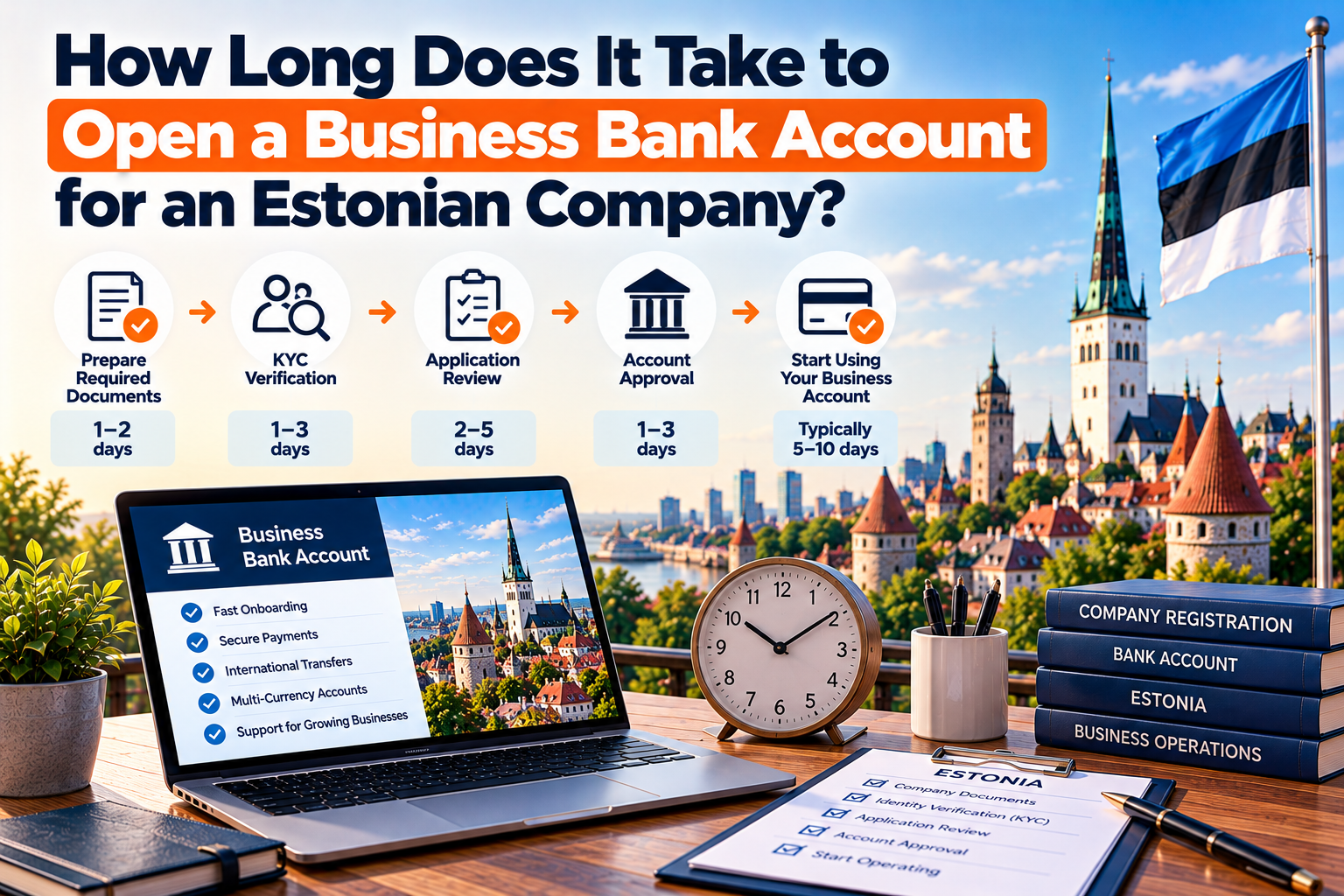
Registering an Estonian company does not automatically provide a business bank account or guarantee access to financial services.
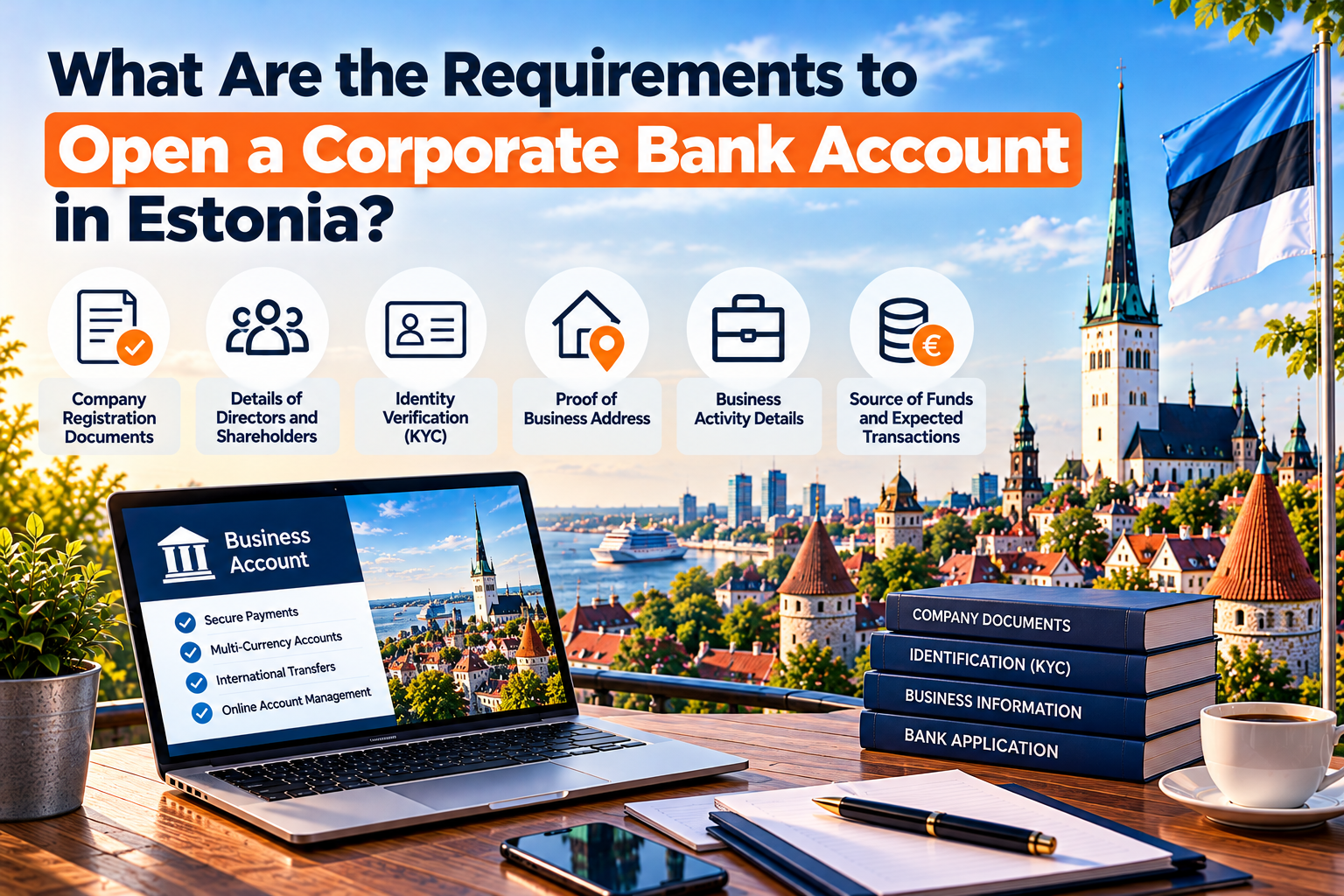
Account opening is a separate process involving identity verification, company due diligence and eligibility checks.
Traditional banks may request:
Some applications may require an in-person appointment.
Eligible Estonian companies may also apply for regulated electronic money or payment accounts.
Depending on the arrangement, these may support:
An electronic money account is not a bank deposit account, and its regulatory protections differ.
Neither e-Residency nor company registration guarantees approval.
Yes, potentially.
An Estonian company may qualify for suitable business payment account details even if its founders did not register the company through e-Residency.
Account eligibility depends on the financial institution's requirements, the company's ownership structure and its business activities.
The company may also be able to use an IBAN issued under another participating European country's account framework.
An Estonian company does not necessarily need an IBAN beginning with EE.
Businesses should confirm that their account supports the required incoming and outgoing payment methods.
The basic Estonian corporate tax framework does not depend on whether the company was registered using e-Residency or a notary.
Estonian companies are generally subject to corporate income tax when profits are distributed or certain other taxable payments or expenses arise, rather than simply when ordinary profits are earned and retained.
Other potential obligations include:
No.
For example, an entrepreneur living in the UK who manages an Estonian company from the UK may need to consider UK corporate tax residency and permanent establishment rules.
The tax treatment depends on the company's management, activities and applicable laws and treaties.
Estonian company registration should not be viewed as a guaranteed method of reducing or avoiding taxation in another country.
Whether the company is registered digitally or through a notary, it must comply with applicable Estonian legal requirements.
These generally include:
Maintaining accurate records of income, expenses, assets and liabilities.
Preparing and submitting annual reports in accordance with the applicable deadlines.
Completing relevant tax registrations, declarations and payments.
Keeping company addresses, management details and other required records up to date.
Maintaining accurate information about the individuals who ultimately own or control the company.
Obtaining any additional authorisations required for regulated business activities.
The incorporation method does not eliminate these obligations.
Yes.
An entrepreneur may establish an Estonian company through a notarial procedure and later apply for e-Residency.
Once approved and issued with the digital identity, the entrepreneur may be able to use supported Estonian electronic services to administer the existing company.
The relevant personal identification details must be correctly associated with the company's register records.
Obtaining e-Residency later does not require the company to be incorporated again.
This can be useful for entrepreneurs who initially establish a company without an Estonian digital identity but later want easier access to online administration.
No. Entrepreneurs can register an Estonian company through a notarial procedure without obtaining e-Residency.
Yes. Foreign nationals can generally own and manage Estonian companies without permanently residing in Estonia, subject to applicable requirements.
Yes, if all required parties have another accepted Estonian digital identification method. Otherwise, a notarial procedure is generally required.
A passport can support identity verification during a notarial process, but it does not ordinarily replace the accepted digital identity required for standard online registration.
Not necessarily. For standard online incorporation, all required signatories need accepted digital identification. Where that is not available, a notarial procedure may be used.
Not necessarily. Online incorporation is available to eligible applicants. Notarial arrangements may involve travel, authorised representation or qualifying remote procedures.
Yes. An eligible entrepreneur can apply for e-Residency after establishing an Estonian company.
No. Business account applications are assessed separately.
Yes, provided it has suitable financial arrangements supporting the required currencies, payment methods and destinations.
No. The company's legal status depends on its registered legal form and applicable Estonian law, not whether its founder used e-Residency.
E-Residency is not a legal requirement for registering a company in Estonia.
Foreign entrepreneurs can establish an Estonian company through a notarial procedure without first obtaining an Estonian e-Residency digital identity.
However, e-Residency can make company formation and ongoing administration more convenient by providing access to Estonia's digital business services.
For entrepreneurs planning to operate an Estonian company remotely, obtaining e-Residency may be a practical long-term choice.
Those who do not have an accepted digital identity can still explore the appropriate notarial registration process.
Regardless of the incorporation method, entrepreneurs must consider registered address requirements, accounting, taxation, business payment arrangements and other ongoing legal obligations.
Understanding these responsibilities before registration is essential to establishing a compliant and sustainable business in Estonia.
Disclaimer: This article is provided for general educational purposes only and does not constitute legal, financial, tax, immigration or accounting advice. Company registration procedures, fees, identification requirements and regulatory obligations may change. Applicants should consult official Estonian guidance and qualified professionals where appropriate.