By

October 15, 2026
Can I Set Up an Estonian Company While Living Outside the European Union?
Estonia has become an attractive destination for international entrepreneurs who want to establish a business within the European Union without relocating. Its advanced digital infrastructure, flexible foreign ownership rules, and online company administration services make it possible for many business owners to establish and manage companies remotely.
One of the most common questions among entrepreneurs living in countries outside the European Union is whether they can legally register an Estonian company without becoming an EU resident.
Yes, you can generally set up an Estonian company while living outside the European Union. Estonia allows foreign individuals, including non-EU citizens and residents, to establish and own private limited companies without requiring them to relocate or appoint a local shareholder.
Eligible entrepreneurs can also register an Estonian company electronically using accepted digital identification and signing methods.
However, establishing a company in Estonia does not automatically provide EU residency, guarantee access to business banking, or eliminate tax obligations in the country where the entrepreneur lives.
This guide explains how non-EU residents can establish Estonian companies, the registration requirements, potential advantages, and important international tax and compliance considerations.
Yes. Estonian company law generally allows foreign individuals and legal entities to establish companies regardless of whether they reside within the European Union.
There is no general requirement for the shareholder of an Estonian private limited company to live in Estonia or another EU member state.
This makes Estonia an option for entrepreneurs based in countries across North America, South America, Asia, Africa, the Middle East, and other regions.
These activities remain subject to applicable identification, registration, sanctions, and regulatory requirements.
No. European Union citizenship is not generally required to establish or own an Estonian private limited company.
Estonia permits full foreign ownership of companies, subject to applicable legal requirements.
This means that entrepreneurs who do not hold an EU passport may still establish an Estonian company.
However, company ownership and immigration rights are separate matters.
Registering an Estonian company does not automatically grant permission to enter, live, or work in the European Union.
Yes. A non-EU resident can generally own all shares in an Estonian private limited company.
There is no general requirement to appoint an Estonian or EU shareholder.
An Estonian private limited company can have a single shareholder, making it suitable for entrepreneurs who want complete ownership of their businesses.
Complete ownership: The entrepreneur can hold all shares in the company.
Independent decision-making: A sole shareholder can exercise ownership rights without coordinating with additional shareholders, subject to applicable law.
Flexible management: The shareholder can generally appoint themselves as the sole management board member.
Profit distribution rights: The owner may receive dividends when distributions comply with company law and tax requirements.
Future investment opportunities: Additional shareholders or investors may be introduced as the business grows.
The company remains a separate legal entity, even when one individual owns all its shares.
Yes. A non-EU resident can generally serve as the sole management board member of an Estonian private limited company.
In Estonia, the management board is responsible for managing and representing the company.
There is no general requirement to appoint an Estonian-resident management board member solely because the company is incorporated in Estonia.
However, the location where management decisions are made may influence the company's international tax obligations.
Not necessarily. Eligible entrepreneurs can establish an Estonian company without travelling to Estonia.
The country's electronic registration system allows many incorporation procedures to be completed remotely.
To register electronically, the required signatories must possess an accepted digital identification and signing method.
However, some applicants may need to complete identification procedures in person outside Estonia.
Certain ownership structures or registration circumstances may also require an alternative incorporation process.
E-Residency is a government-issued digital identity programme that enables eligible non-residents to access selected Estonian electronic services.
It is particularly useful for entrepreneurs who want to establish and administer Estonian companies remotely.
E-Residency should be understood as a digital business administration tool rather than an immigration programme.
Yes. Eligible individuals can generally apply for Estonian e-Residency while living outside the EU.
The application process is primarily electronic.
The card collection appointment normally requires personal attendance for identity verification.
However, collection locations may be available outside Estonia.
Applicants should verify the availability of a suitable collection location before applying.
The company formation process generally involves several steps.
Select the appropriate legal structure for the intended business.
For many international entrepreneurs, the private limited company, known as an OÜ, is a suitable option.
Choose a unique company name that complies with Estonian registration requirements.
Obtain an accepted digital identity if planning to complete incorporation electronically.
Provide a registered address that meets the applicable legal requirements.
An authorised contact person in Estonia may also be required depending on the company's circumstances.
Identify the shareholders and management board members.
A non-EU resident can generally serve as both the sole shareholder and sole management board member.
Select an appropriate share capital amount and comply with the relevant contribution requirements.
Compile the articles of association, shareholder details, management information, beneficial ownership information, and other required documentation.
Complete the electronic or alternative incorporation procedure and pay the applicable registration fee.
Once approved, the company is entered into the Estonian Commercial Register and receives its official registration number.
Establish suitable financial services and implement the necessary accounting and tax procedures.
The exact requirements depend on the registration method, ownership structure, and applicant's circumstances.
Additional documentation may be required where the shareholder is another legal entity.
Certain documents may need certification, translation, or legalisation depending on the incorporation procedure.
No. An Estonian private limited company does not generally require an Estonian business partner or local shareholder.
A foreign entrepreneur can generally establish and own the company independently.
However, the company may need an appropriate registered address and an authorised contact person in Estonia.
These administrative requirements are separate from company ownership.
Business partner: An individual or entity that participates in business ownership or a commercial relationship.
Shareholder: An individual or entity that owns shares in the company.
Management board member: A person responsible for managing and representing the company.
Authorised contact person: A person or entity authorised to receive certain official communications.
Appointing a contact person does not automatically give that person ownership or management rights.
An Estonian private limited company does not generally need a conventional physical office solely because it is registered in Estonia.
However, the company must maintain a registered address that complies with applicable law.
Depending on its registered location, an authorised contact person in Estonia may also be required.
Foreign entrepreneurs can often arrange appropriate address and contact person services remotely.
However, a registered address does not necessarily determine where the company's actual management or business activities take place for tax purposes.
Estonian private limited companies can be established with relatively low share capital.
The minimum nominal value of a share can be as low as €0.01.
However, entrepreneurs should choose an amount appropriate to their business needs.
Special shareholder liability considerations may apply where share capital is below €2,500.
The statutory minimum should not be confused with the amount of capital needed to operate the business effectively.
The total cost depends on the registration method and the additional services required.
E-Residency application: A fee applies if the entrepreneur needs an Estonian digital identity.
Company registration: An applicable state fee must be paid.
Registered address: Commercial address services may involve recurring charges.
Contact person: Additional costs may apply where a contact person is required.
Accounting services: Companies must maintain proper financial records and comply with reporting obligations.
Business banking: Financial institutions may charge account maintenance or transaction fees.
Professional assistance: Entrepreneurs may incur additional legal, tax, or incorporation advisory expenses.
Non-EU entrepreneurs should also consider any compliance costs arising in their country of residence.
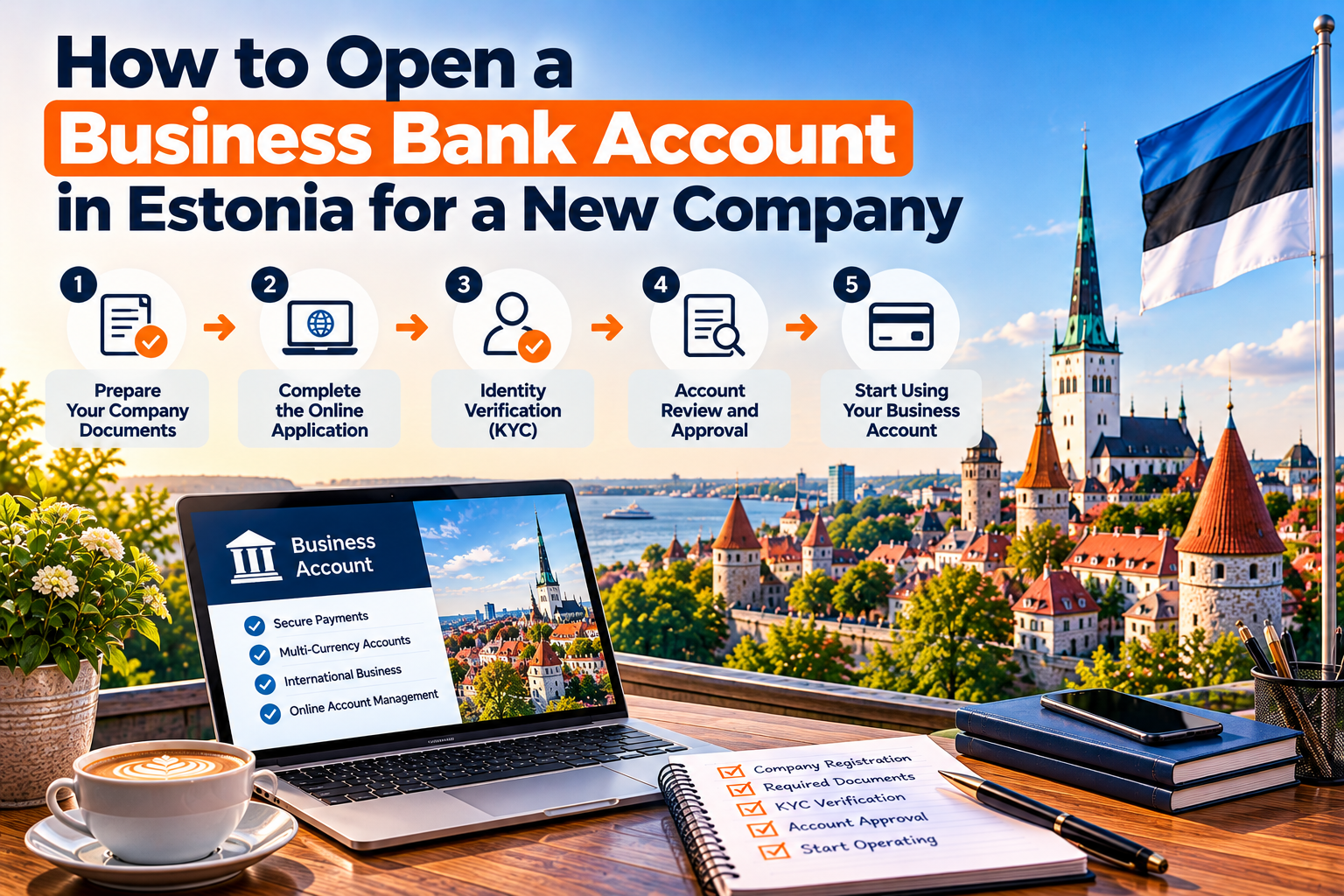
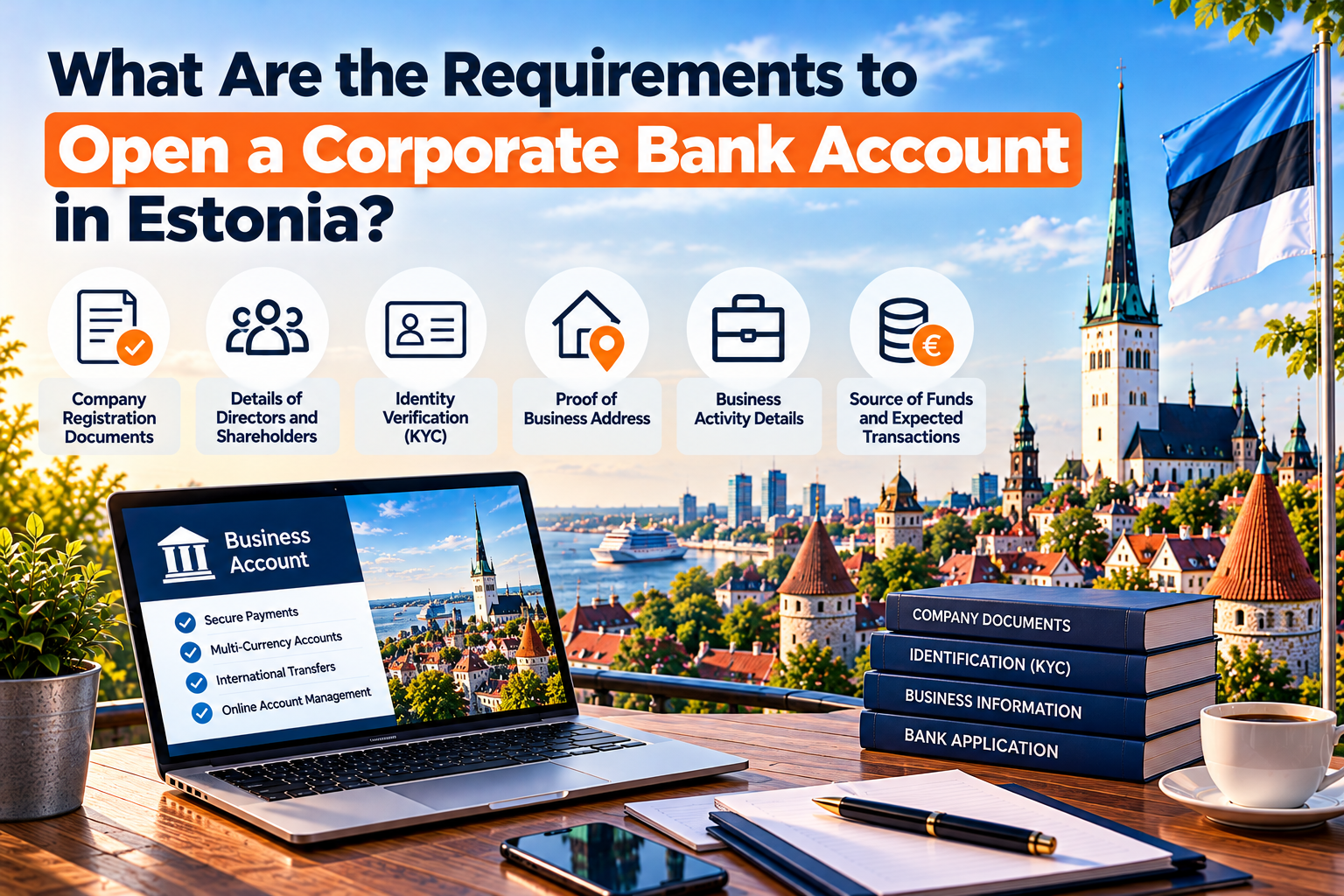
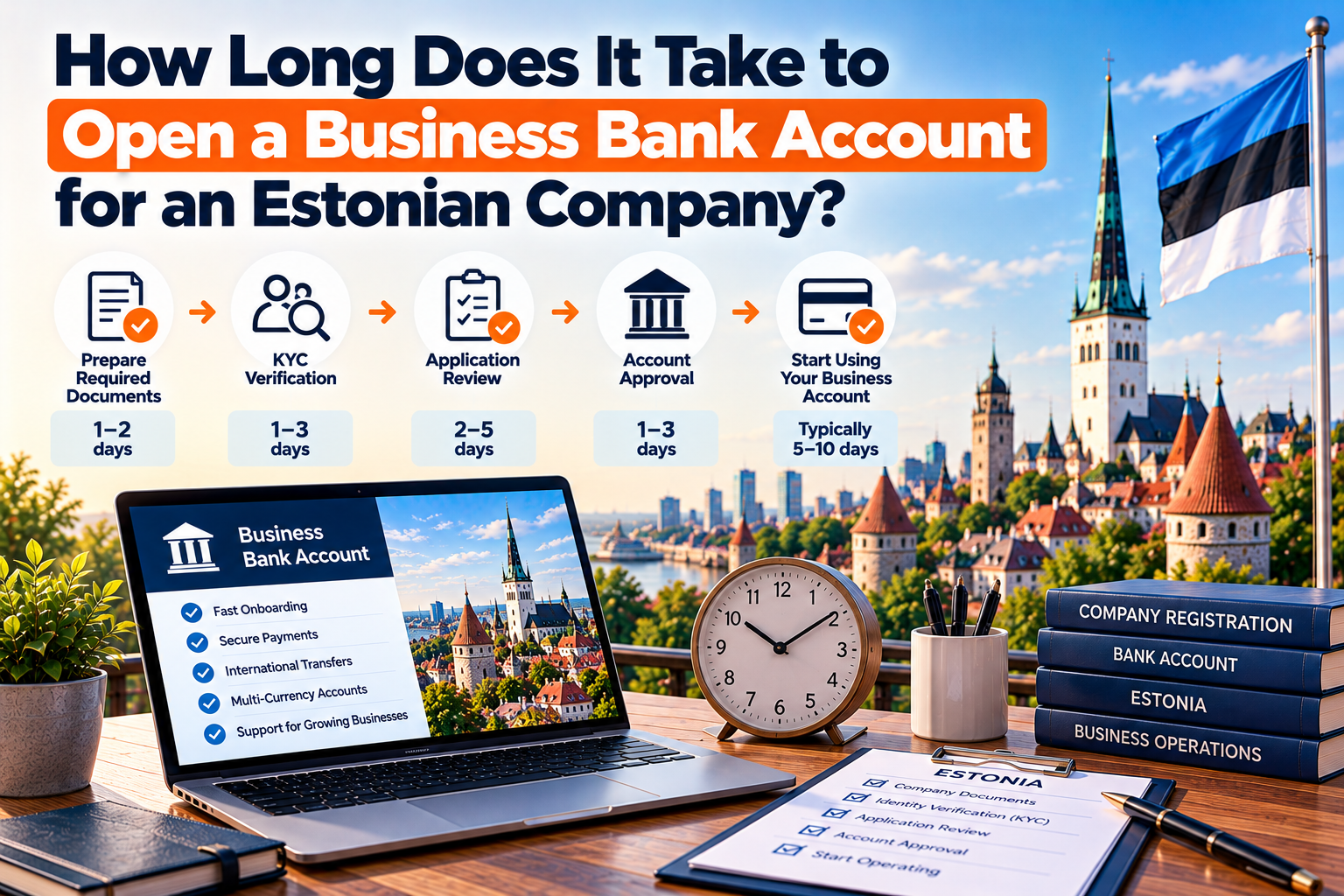
An Estonian company owned by a non-EU resident may apply for a business account with an eligible bank or regulated payment institution.
However, account approval is not automatic.
Financial institutions generally assess the company's ownership, business activities, expected transactions, and compliance profile.
Some financial institutions offer remote onboarding, while others may require additional verification or physical attendance.
The shareholder's country of residence may influence eligibility.
Entrepreneurs should investigate suitable banking arrangements before incorporating.
An Estonian company may be able to open an eligible business account supporting euro-denominated payments.
This can be useful for businesses serving customers within the European Union.
However, access to particular payment systems depends on the financial institution, account eligibility, and applicable regulatory requirements.
Company registration alone does not guarantee access to specific banking services.
Estonia has a distinctive corporate income tax framework.
Ordinary profits retained within an Estonian company are generally not subject to immediate Estonian corporate income tax.
Corporate income tax generally applies when profits are distributed or certain taxable payments and expenses arise.
Reinvestment opportunities: Retained earnings may be used to finance business expansion.
Improved cash flow: Companies may preserve funds for operational requirements.
Flexible dividend planning: Profit distributions can be planned according to business needs, subject to legal and tax requirements.
Long-term business development: The system may be attractive to companies that reinvest substantial portions of their earnings.
However, Estonia is not a tax-free jurisdiction.
Non-EU residents must consider the tax rules of their country of residence and any other jurisdiction where the company operates.
Possibly. This is one of the most important considerations for entrepreneurs living outside the European Union.
An Estonian company may have tax obligations in another country depending on where its management and business activities take place.
Some jurisdictions consider the location where key management and commercial decisions are made when determining corporate tax residence.
Business operations conducted in another country may create a taxable presence there.
The shareholder may remain personally tax resident in their country of residence.
Payments received from the Estonian company may be taxable in the shareholder's home country.
Applicable tax treaties may help determine taxing rights and provide mechanisms for relieving double taxation.
The precise treatment depends on the countries involved and the company's circumstances.
Yes. US citizens and residents can generally establish and manage Estonian companies.
However, US tax rules may impose additional obligations on owners of foreign corporations.
US entrepreneurs should obtain appropriate international tax advice before incorporating.
Yes. UK residents can generally establish and manage Estonian companies.
However, UK tax rules may apply depending on where the company's central management and control are exercised.
Estonian incorporation does not automatically remove UK tax liabilities.
Yes. Entrepreneurs living in these regions can generally establish and own Estonian companies, subject to applicable eligibility and regulatory requirements.
However, practical considerations may vary depending on the country of residence.
Entrepreneurs should evaluate both Estonian requirements and the laws of their country of residence.
Yes. A foreign legal entity established outside the European Union can generally own an Estonian private limited company.
This allows international businesses to establish wholly owned European subsidiaries.
However, corporate shareholders may need to provide additional documentation establishing their legal existence, ownership, and authority to participate in the incorporation process.
International group structures may also involve transfer pricing, accounting, and tax reporting obligations.
Yes. An Estonian company can generally conduct business with customers and suppliers throughout the European Union.
This can be particularly attractive to entrepreneurs who live outside the EU but want to establish commercial relationships within the European market.
However, EU incorporation does not automatically eliminate VAT, customs, licensing, or other regulatory obligations.
The applicable rules depend on the company's actual activities and where goods or services are supplied.
No. Establishing an Estonian company does not automatically grant the shareholder permission to live or work in Estonia or another European Union country.
Company ownership and immigration status are separate legal matters.
Entrepreneurs who want to relocate to Estonia must qualify under an applicable immigration route.
Estonia can accommodate a wide range of commercial activities.
Its digital infrastructure may be particularly attractive to internationally focused businesses.
Certain industries may require additional licences, registrations, or regulatory approvals.
Estonia offers several potential benefits for non-EU entrepreneurs.
Non-EU residents can generally own 100% of an Estonian private limited company.
Eligible entrepreneurs can establish companies electronically.
An Estonian company provides a corporate structure registered within an EU member state.
Many corporate responsibilities can be managed online.
Foreign individuals can generally serve as management board members without relocating.
Private limited companies can be established with relatively low share capital.
Estonia's corporate tax framework can support businesses that retain profits for growth, although foreign tax obligations may affect the overall benefit.
Companies can develop commercial relationships with European and international customers.
These advantages make Estonia worth considering for entrepreneurs seeking an international business structure.
Although Estonia offers several advantages, entrepreneurs should consider the potential challenges.
The company may face tax obligations in the country where it is effectively managed or operates.
Some financial institutions may impose additional requirements on companies owned by non-EU residents.
Applicants may need to obtain accepted digital identification or use an alternative incorporation procedure.
Estonian companies must maintain accounting records and submit required annual reports.
Appropriate administrative arrangements must be maintained.
Company ownership does not automatically provide permission to live or work in Estonia.
Certain business activities may require additional licences or approvals.
These considerations should be evaluated before selecting Estonia as the company's jurisdiction of incorporation.
Yes. Foreign individuals can generally establish Estonian companies while living outside Europe, subject to applicable legal and regulatory requirements.
No. EU citizenship is not generally required.
Yes. Full foreign ownership is generally permitted.
No. An Estonian shareholder or equity partner is not generally required.
Yes. One individual can generally serve as both the sole shareholder and sole management board member.
Yes. Eligible entrepreneurs can complete electronic incorporation using accepted digital identification and signing methods.
No. E-Residency is one method of accessing supported digital services, but it is not a legal requirement for owning an Estonian company.
Some financial institutions accept applications from non-EU-owned Estonian companies, but approval depends on their eligibility and compliance requirements.
Possibly. Corporate tax obligations may arise depending on where the company is managed and conducts business.
Yes. Non-resident shareholders may generally receive lawful dividend distributions, subject to applicable tax requirements.
Yes. A foreign legal entity can generally own an Estonian private limited company.
No. Company ownership does not automatically provide immigration or residency rights.
Yes. Estonian companies generally must prepare and submit annual reports, even when business activity is limited.
Entrepreneurs living outside the European Union can generally establish, own, and manage companies in Estonia without relocating.
Estonia's flexible foreign ownership rules, electronic company registration system, and digital administration services make it an attractive option for international business owners seeking a European corporate structure.
Non-EU residents can generally own 100% of an Estonian private limited company, serve as management board members, and manage many administrative responsibilities remotely.
However, company registration does not automatically provide EU residency, guarantee access to financial services, or eliminate tax obligations in other jurisdictions.
The country where the entrepreneur lives, makes management decisions, employs staff, or conducts business activities may impose additional legal and tax requirements.
For entrepreneurs seeking to establish a company within the European Union while continuing to live elsewhere, Estonia offers a flexible and accessible incorporation framework, provided that the business structure complies with the laws of every relevant jurisdiction.
With appropriate planning, reliable accounting, and ongoing regulatory compliance, an Estonian company can provide a practical foundation for international business operations and European market expansion.