By

October 19, 2026
What Documents Are Required to Start a Company in Spain? Complete Guide
Starting a company in Spain requires entrepreneurs and investors to prepare several legal, identification, and registration documents before completing the incorporation process.
Whether you are a Spanish resident, an EU citizen, or a non-EU investor, understanding the documentation requirements can help simplify company formation and avoid unnecessary administrative delays.
One of the most common business structures in Spain is the Sociedad Limitada (SL), the Spanish equivalent of a private limited liability company.
The documents required to establish an SL generally include identification for shareholders and directors, a company name availability certificate, incorporation documents, company bylaws, and information about the company's share capital and registered office.
Additional documents may be required for foreign shareholders, corporate investors, or businesses operating in regulated industries.
This guide explains what documents are required to start a company in Spain, how to prepare them, and what information you will need when registering your business and opening a company account.
For a typical Spanish limited company, the following documents and information are commonly required:
The exact requirements depend on the legal structure, ownership arrangements, and incorporation procedure.
Some documents must be prepared before incorporation, while others are created or obtained during registration.
The individuals establishing and managing a Spanish company must provide valid identification.
For Spanish nationals, this generally involves a national identity document.
Foreign individuals may be required to provide a valid passport or national identity card, together with the relevant Spanish identification number.
The documentation helps the notary and relevant authorities verify the identities of the individuals participating in the incorporation.
Depending on the circumstances, additional identification or verification procedures may apply.
Foreign individuals involved in Spanish company formation commonly need a Número de Identidad de Extranjero (NIE) for relevant legal and administrative transactions.
The NIE is an identification number assigned to foreign individuals who have qualifying economic, professional, or social interests in Spain.
Foreign companies participating as shareholders may need a Spanish Número de Identificación Fiscal (NIF).
The exact identification requirements depend on the shareholder's legal status and role.
Entrepreneurs should establish which numbers are required before arranging the incorporation documents.
Before establishing a Spanish SL, the founders generally need to obtain a certificate confirming that their proposed company name is available.
This document is known as the certificación negativa de denominación social.
It is issued by the Spanish Central Commercial Registry (Registro Mercantil Central).
The certificate confirms that the proposed name can be used under the applicable company naming rules.
It is advisable to prepare several alternative names in case the preferred name is unavailable.
A Spanish limited company is generally incorporated through a public deed executed before a Spanish notary.
This document is known as the escritura de constitución.
The deed records the essential details of the new company, including:
The deed is an essential document for completing the company's registration with the Commercial Registry.
The company's bylaws, known as estatutos sociales, establish the legal framework governing the company.
They generally include information about:
The bylaws should reflect the company's intended business activities and ownership structure.
Standardized bylaws may be available for eligible electronic incorporation procedures.
The shareholders must determine the amount of share capital to contribute to the company.
For a Spanish Sociedad Limitada, the statutory minimum share capital is €1.
However, additional legal requirements apply while the company's share capital remains below €3,000.
Depending on the incorporation procedure, shareholders may need to provide evidence of their capital contributions.
For monetary contributions, this may involve banking documentation. Spanish SL incorporation rules also provide an alternative declaration mechanism in certain circumstances, rather than requiring a bank certificate.
If shareholders contribute non-cash assets, additional descriptions and supporting documentation may be required.
The share capital documentation must accurately reflect the contributions made by the shareholders.
A Spanish company must establish its registered office, known as the domicilio social.
The address is included in the company's incorporation documents and registration information.
Depending on the circumstances, supporting documents may include:
The registered office should comply with applicable Spanish company law.
Not every incorporation requires the same supporting address documents, but companies should be prepared to demonstrate the legitimacy of their registered office if requested.
The incorporation documents must identify the individuals appointed to manage and represent the company.
Depending on the chosen management structure, an SL may have a sole administrator, joint or several administrators, or a board of directors.
Relevant information may include:
Where an individual acts on behalf of another person or entity, appropriate authorization may be required.
Spanish company formation procedures may require information identifying the individuals who ultimately own or control the company.
These individuals are known as ultimate beneficial owners (UBOs).
Beneficial ownership identification commonly considers individuals who directly or indirectly own or control more than 25% of the company, as well as individuals exercising effective control through other means.
Depending on the ownership structure, the information required may include:
Companies with several layers of corporate ownership may need to provide additional supporting documents.
Beneficial ownership information is also important when opening a business account.
Where a shareholder or director cannot participate personally in the incorporation process, an authorized representative may be appointed.
A power of attorney allows the representative to perform specified legal acts on behalf of the principal.
The document must grant the necessary authority and comply with the applicable legal formalities.
For powers of attorney executed outside Spain, additional authentication or translation requirements may apply.
This arrangement can be particularly useful for foreign investors establishing a Spanish company without travelling to Spain for every administrative step.
If a Spanish company is being established by an existing foreign company, additional corporate documentation is commonly required.
These documents may include:
Documents issued abroad may need to be legalized or apostilled and translated into Spanish.
The exact requirements depend on the country of origin and the incorporation procedure.
A Spanish company requires a Número de Identificación Fiscal (NIF).
The company may initially obtain a provisional NIF during the incorporation process.
After the relevant registration requirements have been completed, the company must obtain or confirm its definitive tax identification documentation.
The company may also need to complete the relevant census declarations with the Spanish Tax Agency.
These procedures help establish the company's tax status and applicable reporting obligations.
Foreign individuals can generally establish and own companies in Spain, subject to applicable legal requirements.
However, additional documentation may be necessary.
Foreign shareholders and directors may need:
Foreign ownership does not automatically prevent company incorporation.
However, preparing international documentation can require additional time.
Yes. Non-resident individuals can generally own shares in Spanish companies.
A Spanish SL may be wholly owned by a foreign individual or foreign company, subject to applicable investment and regulatory rules.
However, owning a Spanish company does not automatically grant the right to reside or work in Spain.
Non-EU entrepreneurs planning to relocate or work in Spain should separately assess the relevant immigration requirements.
Tax residence, company management, and Social Security obligations may also need to be considered.
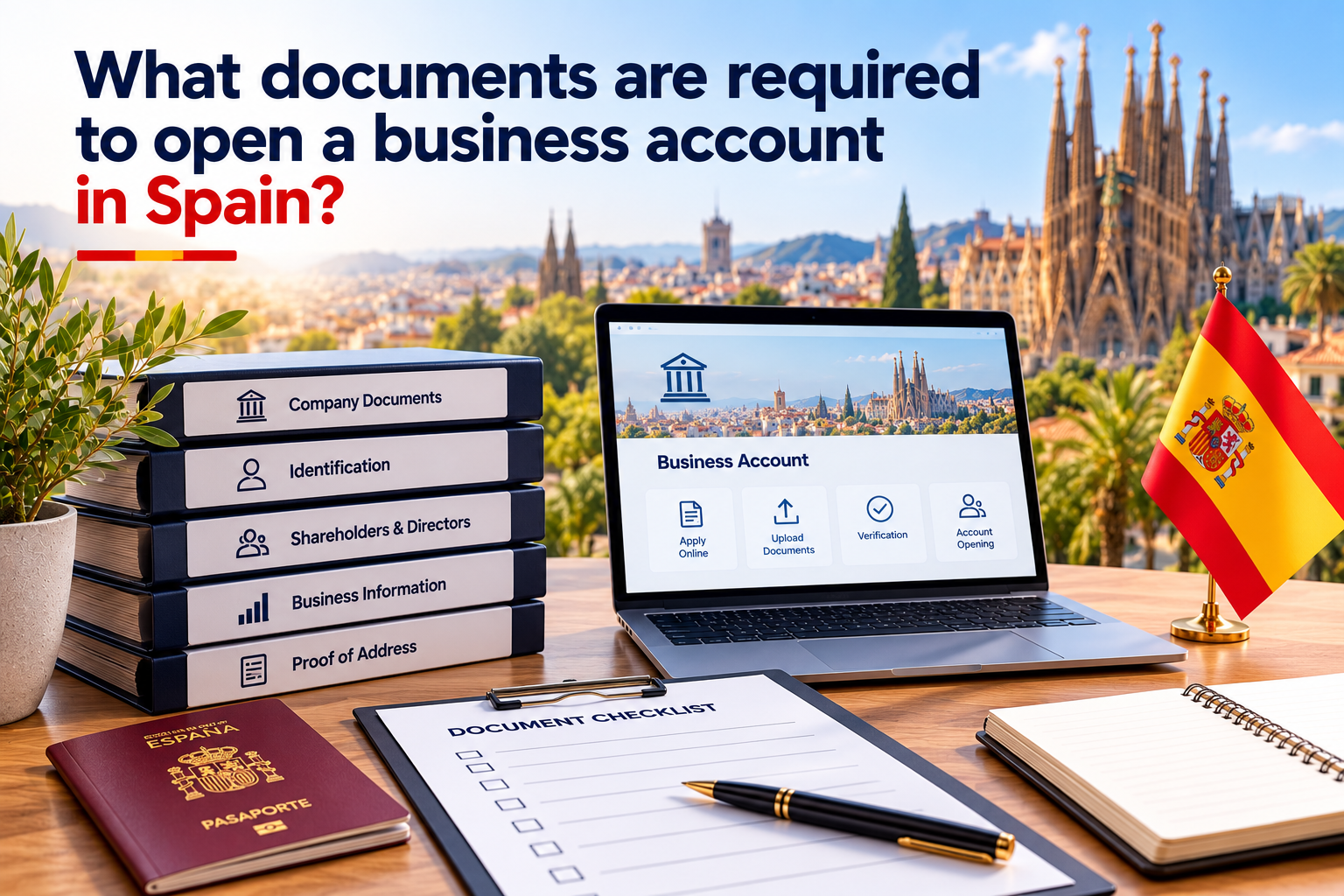
Once the company has the necessary incorporation and registration documentation, it can apply for a business account.
Financial institutions must verify the company's legal status, ownership, representatives, and intended account activities.
Commonly requested documents include:
Some financial institutions also request commercial contracts, invoices, business plans, or other supporting evidence.
The exact requirements depend on the provider and the company's circumstances.
Yes. Some regulated financial institutions allow eligible Spanish companies to open business accounts through online application procedures.
Online onboarding may include electronic document submission, identity verification, and compliance checks.
For companies primarily operating in euros, a dedicated EUR business account with SEPA payment capabilities can help manage domestic and European transactions.
Businesses should verify that the account supports their legal structure, ownership arrangements, and expected payment requirements.
Not necessarily.
A Spanish company may be able to use an eligible European IBAN issued by a regulated financial institution in another EU country.
For euro transactions, SEPA payment services can support transfers between participating European countries.
Under applicable European Union rules, certain forms of IBAN discrimination are prohibited for covered euro credit transfers and direct debits.
However, companies should confirm that their chosen account supports specific requirements for tax payments, payroll, and other administrative transactions.
The time required depends on the founders' circumstances and the complexity of the company.
A straightforward incorporation involving individual shareholders with the required identification numbers may involve relatively little document preparation.
More complex cases may require additional time for:
Preparing these documents in advance can help make the registration process more efficient.
Yes. Spain provides electronic incorporation procedures for eligible companies through the Centro de Información y Red de Creación de Empresas (CIRCE).
The system coordinates several administrative steps involved in company creation.
Depending on the incorporation method, electronic procedures may reduce paperwork and simplify communication between participating authorities.
However, not every incorporation qualifies for the same process, and additional formalities may be required.
Preparing company formation documents carefully can help avoid unnecessary delays.
Common issues include:
Incorrect Identification Information
Names, identification numbers, and personal details should be consistent across documents.
Unavailable Company Names
The proposed company name must satisfy the applicable registration rules.
Incomplete Shareholder Information
The incorporation documents should accurately identify all shareholders and their contributions.
Unclear Management Arrangements
The company's directors, representation powers, and governance structure should be properly documented.
Missing Foreign Document Authentication
Foreign documents may require an apostille, legalization, or certified translation.
Incomplete Beneficial Ownership Information
Complex ownership structures should be clearly documented.
Incorrect Company Address
The registered office information should be accurate and suitable for the company's legal requirements.
Common requirements include shareholder identification, the company name availability certificate, incorporation deed, bylaws, share capital details, director information, and tax identification documentation.
Foreign individuals commonly need an NIE for relevant Spanish company formation procedures, although the exact requirements depend on their role and circumstances.
Foreign individuals may need a valid passport or other accepted identification document.
A Spanish company must establish an appropriate registered office address in accordance with applicable company law.
Not always. Spanish SL incorporation rules provide an alternative declaration mechanism for monetary contributions in certain circumstances.
The statutory minimum is €1. Additional legal rules apply while share capital remains below €3,000.
Depending on the circumstances, foreign shareholders may use authorized representatives or available electronic procedures.
Depending on the country of origin, document type, and applicable international agreements, foreign documents may require an apostille or other legalization.
Yes. Eligible incorporations can use electronic procedures, although additional formalities may still be required.
Commonly requested documents include company registration records, incorporation documents, company NIF, director identification, beneficial ownership details, and business activity information.
Starting a company in Spain requires entrepreneurs to prepare identification documents, company name registration information, incorporation documents, bylaws, share capital details, and relevant tax documentation.
For foreign shareholders and international investors, additional identification, representation, and document authentication requirements may apply.
Preparing these documents before beginning the incorporation process can help reduce administrative delays and make company registration more efficient.
Once the company has been established, arranging a suitable business account is an important step in preparing for commercial operations.
For Spanish companies primarily conducting euro transactions, an online EUR business account with SEPA payment capabilities can help manage customer payments, supplier transfers, and other business expenses across Europe.
Looking for a Business Account for Your New Company in Spain?
If you are establishing a Spanish SL or have recently completed company registration, explore online EUR business account solutions for eligible European businesses.
A dedicated EUR IBAN with SEPA payment capabilities can help your company receive customer payments, pay suppliers, and manage euro transactions across Europe.