By

October 19, 2026
What are the steps to register a company in Spain?
Registering a company in Spain is an important step for entrepreneurs, foreign investors, and international businesses looking to establish a presence in the European Union.
Spain offers several business structures, a recognized legal framework, access to the European Single Market, and electronic company formation procedures that can simplify the registration process.
Whether you are a Spanish resident, an EU citizen, or a non-EU entrepreneur, understanding the company registration process can help you establish your business efficiently and avoid unnecessary administrative delays.
One of the most common legal structures for entrepreneurs is the Sociedad Limitada (SL), the Spanish equivalent of a private limited liability company.
This guide explains the steps to register a company in Spain, including the legal requirements, necessary documents, company name registration, share capital, tax identification, Commercial Registry procedures, and opening a business account.
Both Spanish nationals and foreign individuals can generally establish companies in Spain, subject to applicable legal and administrative requirements.
Foreign entrepreneurs can usually:
However, registering a company does not automatically provide the right to reside or work in Spain.
Non-EU nationals planning to live and work in Spain may require an appropriate residence or work authorization.
Certain regulated industries and foreign investments may also be subject to additional requirements.
The first step in registering a company in Spain is selecting the most appropriate legal structure.
The choice depends on the nature of the business, number of shareholders, capital requirements, liability considerations, and future expansion plans.
A Sociedad Limitada is a commonly used structure for small and medium-sized businesses, startups, consulting companies, and foreign-owned businesses.
An SL offers a separate legal identity and generally limits shareholder liability, subject to statutory exceptions.
It can be established with one or more shareholders, including foreign individuals or companies.
The general minimum share capital for an SL is €1, although additional legal obligations apply while share capital remains below €3,000.
A Sociedad Anónima is generally used by larger businesses or companies requiring a more complex shareholding structure.
The statutory minimum share capital is €60,000, with specific rules governing capital contributions.
An existing foreign company may establish a branch in Spain to conduct local business activities.
A branch is generally not legally separate from its parent company.
An autónomo operates as a self-employed individual rather than through a separate limited company.
This option may be suitable for freelancers and independent professionals, although personal liability considerations differ from those of a limited company.
For many entrepreneurs looking to establish a separate corporate entity, an SL is a practical starting point.
Before registering a company in Spain, shareholders, directors, and representatives may need the appropriate identification numbers.
Foreign individuals commonly require a Número de Identidad de Extranjero (NIE) for relevant legal and administrative transactions.
Foreign corporate shareholders may need a Spanish tax identification number (NIF).
These identification numbers help Spanish authorities verify the individuals and entities involved in the company formation process.
The exact requirements depend on the nationality, legal status, and role of each participant.
A Spanish limited company generally needs a certificate confirming that its proposed company name is available.
This is known as the certificación negativa de denominación social.
The certificate is issued by the Registro Mercantil Central, Spain's Central Commercial Registry.
It confirms that the proposed name does not conflict with an existing registered company name under the applicable naming rules.
Entrepreneurs should consider several possible names before submitting their application.
The selected company name must comply with Spanish corporate naming requirements and include the appropriate legal designation.
Once the legal structure and company name have been selected, the shareholders must determine the company's share capital.
For a Sociedad Limitada, the statutory minimum share capital is €1.
However, companies established with capital below €3,000 are subject to additional rules.
These include requirements relating to the allocation of profits to legal reserves and certain shareholder liability provisions if the company is liquidated with insufficient assets to satisfy its obligations.
Although the minimum legal capital can be low, entrepreneurs should consider the amount of funding needed to support their business operations.
Depending on the incorporation procedure, evidence of capital contributions may be required.
The next step is preparing the documents required to establish the company.
These generally include the company's constitutional documents and information about its ownership and management.
Important details include:
The company's bylaws, known as estatutos sociales, form an important part of the incorporation documentation.
These documents establish the framework for how the company will be managed.
A Spanish limited company is generally incorporated through a public deed signed before a Spanish notary.
This document is known as the escritura de constitución.
The deed records the company's establishment and includes essential information about its shareholders, capital, directors, and constitutional rules.
Shareholders may sign personally or, where permitted, through authorized representatives.
Foreign shareholders who cannot attend in person may be able to appoint a representative using an appropriately executed power of attorney.
The notary verifies the relevant legal formalities before the incorporation proceeds.
Every Spanish company requires a Número de Identificación Fiscal (NIF).
The NIF identifies the company for Spanish tax and administrative purposes.
A provisional NIF may be issued during incorporation, followed by definitive tax identification once the relevant requirements have been completed.
The company's NIF is used for activities such as:
Obtaining the correct tax identification documentation is an essential part of the registration process.
After the incorporation deed has been executed, the company must be registered with the relevant provincial Commercial Registry, known as the Registro Mercantil.
Registration is a fundamental step in establishing a Spanish limited company as a fully registered legal entity.
The Registry records the company's legal details, including its name, registered office, share capital, and management structure.
Once the registration has been completed, the company can obtain official documentation confirming its registered status.
This documentation is commonly required for financial, administrative, and commercial purposes.
After incorporation, the company must complete the applicable tax and business activity registrations.
These procedures may include:
The exact obligations depend on the company's activities, location, and intended operations.
Companies planning to provide services or sell products to customers in other EU countries should also assess the VAT rules applicable to cross-border transactions.
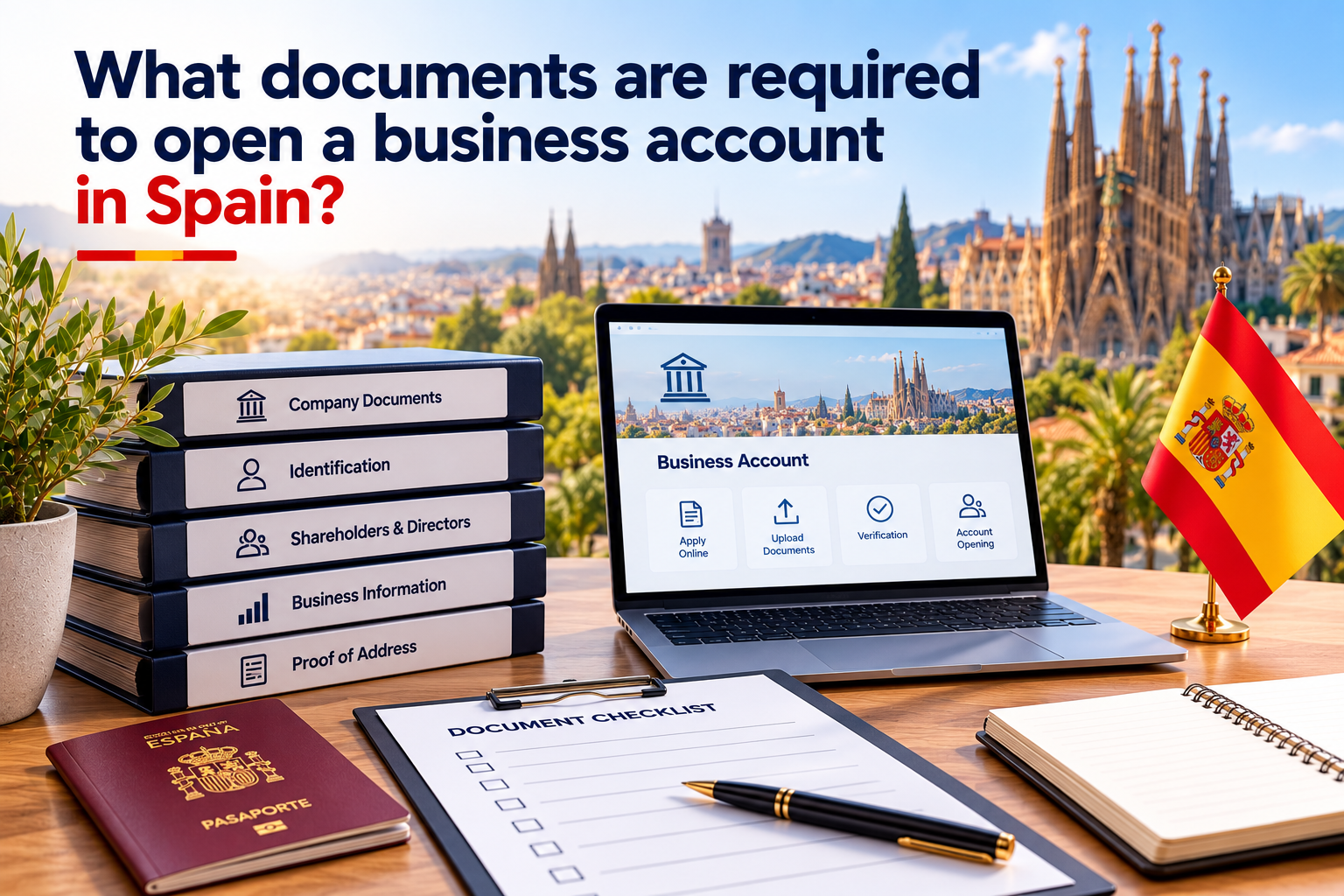
Opening a dedicated business account is an important step in preparing the company for commercial operations.
A business account helps separate company finances from personal transactions and supports everyday financial management.
Spanish companies may choose between traditional bank accounts and eligible online business payment accounts offered by regulated financial institutions.
For companies primarily operating in euros, a dedicated EUR business account with SEPA payment capabilities can provide a convenient way to manage domestic and European payments.
A dedicated business account can help companies:
Yes. Some regulated financial institutions allow eligible Spanish companies to apply for business accounts online.
The application process generally includes submitting company registration documents, providing identification details for directors and beneficial owners, and completing compliance verification.
Companies with foreign shareholders or non-resident directors should verify that their ownership structure is supported.
Not necessarily.
Spanish companies may be able to use eligible European IBANs issued by regulated financial institutions in other EU countries.
For euro payments, SEPA provides standardized transfer services across participating European countries.
However, companies should confirm that the account supports their specific payment requirements, including tax payments, payroll, and other administrative obligations.
Companies planning to employ staff must complete the relevant employer registration and Social Security procedures.
Depending on the circumstances, directors and working shareholders may also have personal Social Security obligations.
Employers may need to register employees and comply with payroll, contribution, and employment reporting requirements.
These obligations should be addressed before employees begin work.
Certain business activities in Spain require licences, permits, or administrative declarations.
The requirements depend on the type of business, its location, and the applicable municipal or regional rules.
Activities that may require additional authorization include:
Companies should verify the relevant requirements before beginning operations.
The exact documents depend on the company's legal structure and ownership.
For a Spanish SL, commonly required documents and information include:
Foreign documents may require certified translations, legalization, or an apostille, depending on the circumstances.
Preparing these documents before starting the incorporation process can help reduce delays.
The time required to register a company in Spain varies according to the incorporation procedure and the complexity of the application.
Straightforward electronic incorporations may be completed relatively quickly, while companies involving foreign shareholders, complex ownership structures, or additional documentation may require more time.
Factors affecting the timeframe include:
Spain provides electronic incorporation procedures for eligible companies, which can simplify certain stages of registration.
However, completing company registration does not necessarily mean that all licences, tax arrangements, and business account services are immediately available.
Yes. Spain provides electronic company formation services through the Centro de Información y Red de Creación de Empresas (CIRCE) system.
The system supports eligible business formation procedures through coordinated electronic processing.
Depending on the legal structure and the circumstances of the founders, certain registration steps can be completed digitally.
However, some incorporations may still require additional formalities, identity verification, or notarization arrangements.
Foreign entrepreneurs should confirm whether their company structure and documentation qualify for the available electronic procedures.
The total cost depends on the company structure, incorporation method, and professional services required.
Potential expenses include:
For an SL, the statutory minimum share capital is €1, but this should not be confused with the total cost of incorporation.
Businesses should also budget for ongoing accounting, tax compliance, and operating expenses.
Yes. Foreign individuals and businesses can generally register companies in Spain.
A Spanish limited company may be wholly owned by foreign shareholders.
Foreign entrepreneurs do not necessarily need to reside in Spain to own shares in a Spanish company.
However, the incorporation process may involve additional identification and documentation requirements.
Foreign ownership also does not automatically provide immigration or employment rights in Spain.
Non-EU entrepreneurs intending to live and work in Spain should separately assess the relevant residence and work authorization requirements.
Once a company has been registered, it must comply with applicable corporate, accounting, tax, and administrative requirements.
These may include:
Accounting Records
Maintaining accurate records of income, expenses, assets, liabilities, and business transactions.
Corporate Tax
Preparing and submitting corporate income tax returns where required.
VAT Compliance
Charging, reporting, and paying VAT where applicable.
Annual Accounts
Preparing and filing annual financial statements in accordance with Spanish company law.
Commercial Registry Obligations
Updating registered company information when relevant changes occur.
Payroll and Social Security
Complying with employment-related obligations where the company hires staff.
Business Licences
Maintaining any permits or authorizations required for the company's activities.
Understanding these obligations from the beginning can help a company operate efficiently and remain compliant.
The first step is to choose the appropriate legal structure. For entrepreneurs establishing an SL, the process normally continues with obtaining identification numbers and reserving the company name.
Yes. Foreign individuals and businesses can generally establish Spanish companies, subject to applicable legal and administrative requirements.
Yes. Non-residents can generally own Spanish companies, although identification, tax, management, and regulatory requirements may apply.
The statutory minimum share capital is €1. Additional legal requirements apply while the company's capital remains below €3,000.
A Spanish limited company is generally incorporated through a public deed executed before a notary, subject to the applicable incorporation procedures.
Processing times depend on the incorporation method, documentation, ownership structure, and relevant administrative procedures.
Yes. Eligible businesses can use electronic company formation procedures, although some cases may require additional formalities.
A dedicated business account is strongly advisable for managing company transactions and maintaining separate financial records. Specific account requirements depend on the company's circumstances and obligations.
Yes. Eligible European IBANs can support covered SEPA payments, subject to applicable requirements and account capabilities.
Generally, yes. A Spanish SL may be wholly owned by a non-EU individual or company, subject to any applicable investment screening or sector-specific restrictions.
Registering a company in Spain involves choosing the appropriate legal structure, obtaining the necessary identification numbers, reserving a company name, preparing incorporation documents, and completing the required notarial and Commercial Registry procedures.
Once the company is registered, entrepreneurs must address tax obligations, Social Security requirements, business licences, and financial arrangements.
For many entrepreneurs, a Sociedad Limitada (SL) offers a practical structure for establishing a separate limited liability company in Spain.
Foreign investors can generally establish and own Spanish companies, and eligible businesses may benefit from electronic incorporation procedures.
Opening a suitable business account is also an important step in preparing for commercial operations.
For companies primarily conducting transactions in euros, an online EUR business account with SEPA payment capabilities can help manage customer payments, supplier transfers, and other European business transactions.
Looking for a Business Account for Your Newly Registered Company in Spain?
If you are registering a company in Spain or have recently incorporated a Spanish SL, explore online EUR business account solutions designed for eligible European businesses.
A dedicated EUR IBAN with SEPA payment capabilities can help your company receive customer payments, pay suppliers, and manage euro transactions across Europe.