By

October 19, 2026
How to Open a Business Account in Spain: A Complete Guide for Companies
Opening a business account in Spain is an important step for companies looking to manage their finances, receive customer payments, pay suppliers, and conduct business transactions efficiently. Whether you are establishing a new Spanish company, operating an existing business, or managing a foreign-owned company registered in Spain, having a dedicated business account can simplify your financial operations.
Spanish companies can choose from traditional business bank accounts and eligible online business payment accounts offered by regulated financial institutions. Depending on the provider, businesses may also be able to open an account remotely and access euro payment services throughout the Single Euro Payments Area (SEPA).
This guide explains how to open a business account in Spain, the documents required, the application process, and the benefits of using a European business account for domestic and international transactions.
A dedicated business account helps companies separate business transactions from personal finances and maintain accurate financial records.
For companies registered in Spain, particularly a Sociedad Limitada (SL) or Sociedad Anónima (SA), maintaining clear financial records is essential for accounting, tax reporting, and everyday business management.
A business account can help companies:
Having a dedicated account also makes it easier to track company income and expenditure, monitor cash flow, and manage financial obligations.
Yes. Spanish companies can apply for business accounts online through financial institutions that support remote onboarding.
Online business accounts can be particularly useful for startups, small and medium-sized enterprises, international businesses, and companies with directors or shareholders residing outside Spain.
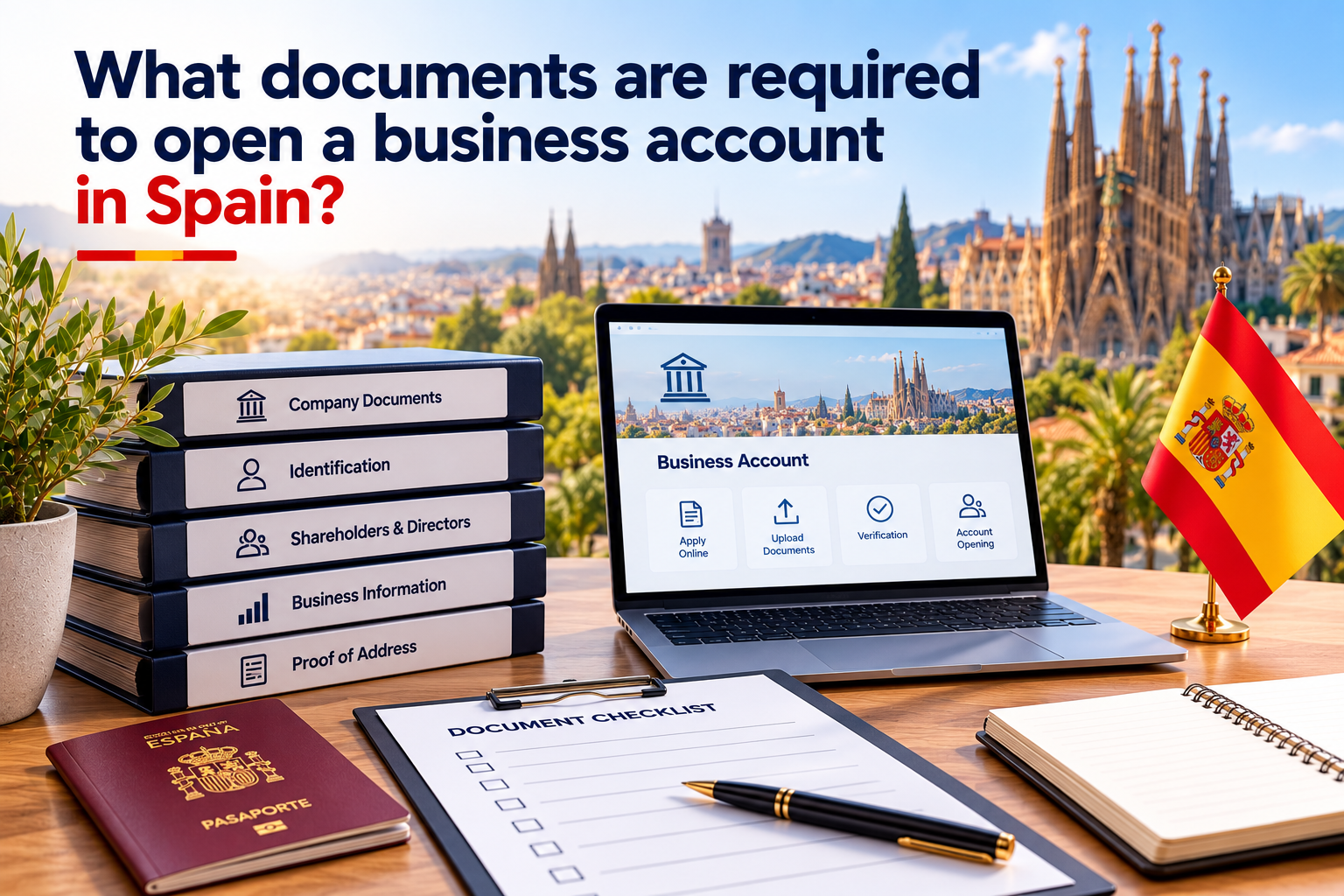
The online application process generally involves submitting company information, uploading identification documents, verifying beneficial ownership, and completing compliance checks.
Depending on the financial institution and the complexity of the company's ownership structure, additional documentation or verification may be required.
Opening a business account online can reduce the need for physical appointments and allow company representatives to complete much of the application remotely.
However, online applications remain subject to eligibility criteria, identity verification, and regulatory approval.
The documents required to open a business account depend on the company's legal structure, ownership, activities, and the financial institution's compliance requirements.
For a Spanish limited company, commonly requested documents include:
The financial institution may request evidence that the business is legally registered in Spain.
This can include a current extract or certificate from the Spanish Commercial Registry (Registro Mercantil).
The company's deed of incorporation (escritura de constitución) and articles or bylaws may be required to confirm its legal structure and governance arrangements.
Spanish companies generally require a Número de Identificación Fiscal (NIF), which identifies the business for tax purposes.
The financial institution will normally request the company's tax identification details during onboarding.
Company directors and authorized representatives may need to provide valid identification, such as a passport or national identity card.
Foreign representatives may also be asked for their Spanish foreigner identification number (NIE), where applicable.
Financial institutions are required to identify and verify the individuals who ultimately own or control the company.
This process is commonly known as Ultimate Beneficial Owner (UBO) verification.
Supporting documents may be requested to establish the company's ownership and control structure.
A company may need to provide evidence of its registered office or operating address.
Accepted documents depend on the provider and may include company registration records, lease agreements, or other official documentation.
The financial institution may request information about the company's commercial activities, expected transactions, customer base, suppliers, and anticipated payment volumes.
For established businesses, supporting evidence such as contracts, invoices, or financial statements may also be requested.
Preparing these documents in advance can help reduce delays during the application process.
The process of opening a business account in Spain generally involves the following steps.
Before applying, determine which account features your company requires.
Consider whether your business needs:
For businesses primarily operating in euros, a European business account with SEPA payment capabilities may provide a practical solution.
Financial institutions apply different eligibility criteria depending on the company's registration country, business activities, ownership structure, and geographical exposure.
Before applying, confirm that the provider accepts Spanish-registered companies and supports your business sector.
Companies with foreign directors or shareholders should also verify whether non-resident ownership and management structures are supported.
Most online applications require basic information about the company, including:
Providing complete and accurate information can help the financial institution assess the application efficiently.
After completing the application, submit the requested corporate and identification documents.
The financial institution may require additional information depending on the company's activities or ownership structure.
Financial institutions must conduct customer due diligence and anti-money laundering checks.
These procedures typically include verifying company registration, confirming the identity of directors and beneficial owners, and understanding the intended purpose of the account.
Some applicants may need to complete additional identity verification procedures.
Once the application has been reviewed and approved, the company can receive its account details.
Depending on the provider, these may include a dedicated IBAN, online account access, and available payment services.
The company can then begin using the account in accordance with the provider's terms and permitted activities.
Yes. A Spanish company may be able to open an eligible business payment account with a regulated financial institution located elsewhere in the European Union or European Economic Area.
This means that a Spanish company does not necessarily need an IBAN beginning with ES to receive and send euro payments.
For example, a company registered in Spain may be able to use an eligible European IBAN to receive SEPA Credit Transfers from customers and make payments to suppliers.
Under applicable EU SEPA rules, payment account holders generally cannot be required to use an IBAN from a particular member state for covered euro credit transfers and direct debits, provided the relevant account is reachable.
This is commonly referred to as IBAN discrimination.
However, the ability to use a non-Spanish IBAN for a particular service can depend on the type of payment, account capabilities, and applicable administrative requirements. Certain Spanish tax payment arrangements, payroll services, or other local processes may require additional verification or specific account functionality.
Spanish companies should therefore confirm that their chosen account supports all the transactions they need.
A SEPA business account allows eligible businesses to send and receive euro payments within the Single Euro Payments Area.
SEPA was established to make euro payments across participating European countries more standardized and efficient.
For Spanish companies, a SEPA-enabled business account can be useful when receiving payments from customers or paying suppliers in other European countries.
European payment access: Businesses can send and receive eligible euro transfers across participating SEPA countries.
Simplified payments: SEPA provides standardized payment processes for domestic and cross-border euro transactions.
Efficient supplier payments: Companies can pay European suppliers and service providers using euro transfers.
Improved cash flow management: Businesses can monitor incoming and outgoing payments through their account platform.
Support for international business: Spanish companies trading across Europe can manage euro-denominated transactions without necessarily maintaining separate accounts in every country.
SEPA payment functionality varies between providers. Businesses should confirm whether standard SEPA transfers, SEPA Instant payments, and direct debits are available.
Yes. Companies registered in Spain with foreign shareholders or directors may be eligible to open business accounts.
Foreign ownership does not automatically prevent a Spanish company from obtaining a business account.
However, financial institutions may apply additional verification procedures when directors, shareholders, or beneficial owners reside outside Spain.
These checks may involve:
Companies with transparent ownership structures and well-documented business activities may find it easier to complete the onboarding process.
Approval remains subject to the financial institution's compliance policies and risk assessment.
A Spanish company does not necessarily need to use a Spanish bank for every business transaction.
Depending on its activities and legal obligations, a company may be able to operate using an eligible European business account that supports its required payment services.
For example, a Spanish business receiving euro payments from European customers may be able to use a SEPA-enabled account issued by a regulated provider in another EU country.
However, certain activities may require specific banking functionality or local arrangements.
These can include company incorporation procedures, tax payments, payroll administration, direct debits, or other regulated transactions.
It is therefore important to distinguish between an account that can handle ordinary commercial payments and an account that meets every administrative or statutory requirement of the business.
The time required to open a business account varies according to the financial institution and the company's circumstances.
The main factors influencing processing time include:
Some straightforward online applications may be processed relatively quickly, while more complex cases can require additional review.
Companies should prepare all required documents before applying and respond promptly to requests for clarification.
The cost of a business account depends on the financial institution, account features, and expected transaction activity.
Common charges may include:
Companies should review the applicable fee schedule before opening an account.
For businesses making frequent euro payments, comparing account maintenance costs and SEPA transaction fees can be particularly important.
The lowest monthly fee does not always mean the lowest overall operating cost, especially for companies processing a large number of payments.
Spanish companies may choose between traditional bank accounts and business payment accounts offered by appropriately regulated financial institutions.
Traditional banks may provide a broad range of services, including lending, deposit accounts, and other financial products.
Online business payment account providers may focus on digital account management, electronic payments, and payment-related services.
The most suitable option depends on the company's financial requirements.
Businesses that primarily need to receive customer payments, pay suppliers, and manage euro transfers may find that a dedicated online business payment account meets their operational needs.
However, a payment or electronic-money account is not necessarily a bank deposit account. The regulatory protections, safeguarding arrangements, and available services can differ.
Companies should understand these distinctions before selecting a provider.
Before choosing a business account, companies should evaluate several important factors.
Confirm that the financial institution supports the company's industry and intended transactions.
For companies operating primarily in Europe, the ability to send and receive euro payments through SEPA can be essential.
A digital platform can help directors and authorized employees manage business payments without relying on physical branch visits.
Review monthly charges, payment fees, card fees, and other applicable costs.
Companies with non-resident directors or foreign shareholders should confirm eligibility before submitting an application.
Verify that the financial institution is appropriately authorized and understand the protections applicable to customer funds.
Check whether the account supports the payment types, transaction volumes, and operational requirements of the business.
Choosing an account that aligns with these requirements can support efficient financial management and reduce unnecessary administrative difficulties.
Yes. Some regulated financial institutions allow eligible Spanish companies to complete their business account applications online, including document submission and identity verification.
Yes. Newly incorporated companies can apply for business accounts, although providers may request incorporation documents, company registration details, and information about planned business activities.
Yes. Spanish companies can generally use eligible European IBANs for supported SEPA payments, subject to the provider's capabilities and applicable requirements.
Yes. A Sociedad Limitada may be eligible for an online business account if it meets the financial institution's onboarding and compliance requirements.
Yes. A SEPA-enabled business account can allow a Spanish company to receive eligible euro transfers from customers in other participating European countries.
Yes. Some financial institutions accept applications from Spanish companies managed by non-resident directors. Additional identity and ownership verification may be required.
Companies must meet their legal, accounting, and payment obligations, but the precise account requirements depend on their legal structure and circumstances. A dedicated company account is generally advisable for separating corporate and personal transactions.
Yes. A Spanish company may maintain multiple eligible business accounts, including accounts with providers in different European countries, subject to applicable reporting and compliance obligations.
A Spanish IBAN begins with ES, while IBANs issued in other countries use different country prefixes. Eligible IBANs within SEPA can support standardized euro transfers, although available account features may differ.
Yes. Depending on its regulatory authorization and services, a payment institution or electronic money institution may offer eligible business payment accounts to Spanish companies.
Opening a business account in Spain is an important consideration for companies seeking to manage payments, maintain financial records, and conduct business efficiently.
Whether your company is newly incorporated, established, or foreign-owned, selecting the right account depends on your business activities, payment requirements, ownership structure, and operational needs.
For Spanish companies conducting transactions in euros, an online European business account with SEPA payment capabilities can provide a practical solution for managing domestic and cross-border payments.
By preparing the necessary documents, understanding the onboarding requirements, and choosing an appropriately regulated financial institution, companies can establish an effective payment infrastructure to support their business operations.
Looking for a EUR Business Account for Your Spanish Company?
If your company is registered in Spain and requires a dedicated euro business account for SEPA payments, explore online business payment account solutions designed for eligible European businesses.
A suitable account can help your company receive customer payments, pay suppliers, and manage euro transactions through a convenient digital platform.