By

October 19, 2026
How long does it take to open a business account in Spain?
Opening a business account in Spain is an important step for companies looking to manage their finances, receive customer payments, pay suppliers, and conduct business transactions across Europe.
One of the most common questions asked by business owners is: How long does it take to open a business account in Spain?
The answer depends on several factors, including the type of financial institution, the company's legal structure, the completeness of its documentation, and the complexity of the required verification procedures.
Some straightforward online business account applications may be approved within a few business days, while others can take several weeks, particularly when additional compliance checks or documentation are required. These are general planning estimates rather than guaranteed processing times.
For Spanish limited companies (Sociedad Limitada or SL), startups, small and medium-sized enterprises (SMEs), and foreign-owned businesses, preparing the necessary documents in advance can help make the application process more efficient.
This guide explains the typical business account opening process in Spain, the factors that influence approval times, and how companies can avoid unnecessary delays.
The time required to open a business account in Spain varies depending on the provider and the company's circumstances.
Financial institutions offering online business accounts may provide a relatively streamlined application process, allowing eligible companies to submit documents electronically and complete identity verification remotely.
Traditional banks may require additional administrative procedures, appointments, or in-person verification, depending on their policies.
As a general guide:
These timeframes are indicative only. There is no universal approval period applicable to every business account provider in Spain.
Online business account applications can be more convenient than traditional branch-based procedures because companies may be able to submit their information and documents electronically.
For eligible businesses, remote onboarding can eliminate the need to arrange physical appointments and travel to a financial institution.
The process generally includes:
Although online onboarding can simplify the application process, it does not eliminate regulatory verification requirements.
The financial institution must still complete the necessary checks before activating the account.
Several factors can influence how quickly a Spanish company can open a business account.
Incomplete or inconsistent documentation is a common reason for delays.
Financial institutions generally require information confirming the company's legal existence, ownership, management, and business activities.
Preparing all required documents before applying can help reduce requests for additional information.
The company's legal structure may affect the verification process.
For example, a Spanish limited company with one shareholder and one director may have a relatively straightforward ownership structure.
A company with several corporate shareholders, multiple directors, or international holding entities may require more extensive verification.
Companies with directors or beneficial owners residing outside Spain may be asked to provide additional identification or supporting documents.
The provider may need to verify foreign identification documents and establish the company's international ownership structure.
Foreign ownership does not automatically prevent account approval, but it can influence the verification process.
Financial institutions assess the nature of a company's business activities as part of their compliance procedures.
Businesses may be asked to explain their products, services, customer base, suppliers, and expected transactions.
Certain sectors or transaction patterns may require enhanced due diligence.
Providing a clear and accurate description of the company's activities can help the provider understand the intended use of the account.
Account providers may request estimates of incoming and outgoing payments.
This information helps establish the expected account activity.
Companies should provide realistic information about anticipated turnover, transaction amounts, payment frequency, and countries involved.
Financial institutions must identify and verify the individuals who ultimately own or control the company.
Where ownership involves multiple companies or jurisdictions, additional supporting documents may be required.
Complex ownership structures can therefore increase processing times.
Business account applications are subject to applicable anti-money laundering and customer due diligence requirements.
Depending on the circumstances, the provider may request additional information about the source of funds, commercial activities, or ownership arrangements.
The account cannot be approved until the necessary verification procedures have been completed.
Having the necessary documents ready before submitting an application can help make the process more efficient.
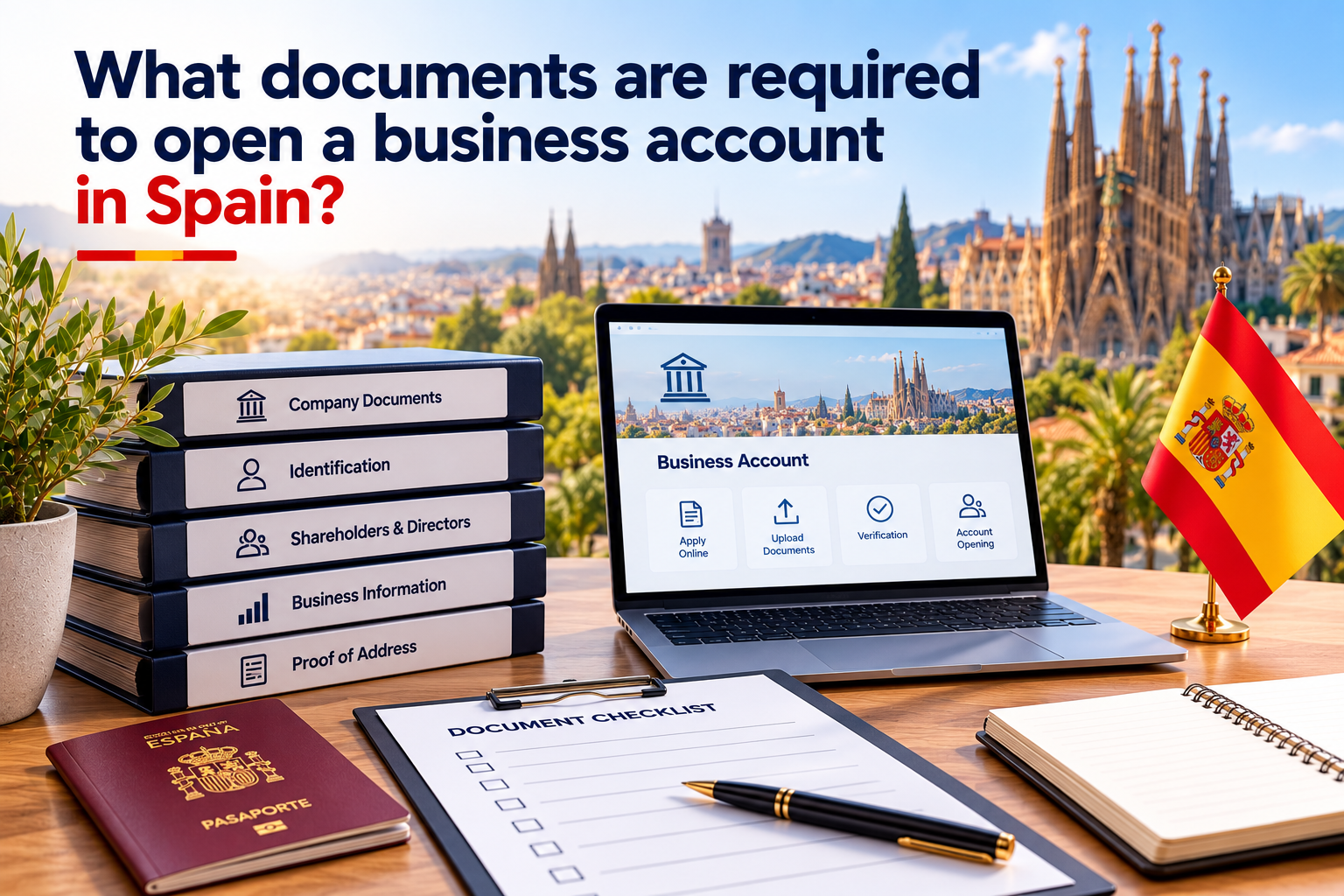
For a Spanish limited company, commonly requested documents include:
Company Registration Certificate
Evidence that the company is registered with the Spanish Commercial Registry (Registro Mercantil).
Deed of Incorporation
The company's incorporation deed (escritura de constitución) and relevant constitutional documents.
Company Tax Identification Number
The company's Spanish Número de Identificación Fiscal (NIF).
Director Identification Documents
Valid identification documents for directors and authorized representatives.
Beneficial Ownership Information
Details of the individuals who ultimately own or control the company.
Proof of Business Address
Documentation confirming the company's registered office or operating address, where required.
Business Activity Description
Information about the company's products, services, customers, and suppliers.
Expected Transaction Information
Estimates of payment volumes, transaction frequency, and countries involved.
Additional documents may be required depending on the provider and the company's circumstances.
Newly incorporated Spanish companies may be eligible to open business accounts even if they have not yet started trading.
However, the provider will normally need sufficient documentation to verify the company's legal status and ownership structure.
A newly established Sociedad Limitada may be asked to provide its incorporation deed, company registration details, tax identification number, and information about planned commercial activities.
Some financial institutions accept companies at an early stage of incorporation, while others require completed registration before opening an operational business account.
If the company is still completing incorporation procedures, obtaining the required documents may add time to the overall process.
It is important to distinguish between opening an operational business account and arranging any separate account or documentation needed for share capital contributions during incorporation.
Spanish companies with foreign shareholders or non-resident directors may be eligible to open business accounts through providers that support international ownership structures.
However, additional verification may be necessary.
For example, the financial institution may request:
The time required depends on the complexity of the ownership structure and the provider's compliance procedures.
Companies can help avoid unnecessary delays by preparing accurate documentation and confirming eligibility before applying.
A Spanish company does not necessarily need to open an account with a Spanish IBAN for every business payment requirement.
Eligible Spanish companies may be able to use a European business account issued by a regulated financial institution in another European country.
For businesses primarily operating in euros, an account with SEPA payment capabilities can provide access to standardized euro transfers across participating countries.
Using a European IBAN does not automatically result in faster account approval.
The processing time still depends on the provider's onboarding procedures, the company's documentation, and the required compliance checks.
Companies should also confirm that the account supports their specific payment needs, including any relevant tax payments, payroll arrangements, and direct debit services.
Once an account has been approved and activated, the company can generally begin using the payment services made available by its provider.
However, account approval and payment activation are not always simultaneous.
Some providers may require additional steps before certain payment functions become available.
For example, the availability of standard SEPA transfers, SEPA Instant payments, and direct debits may differ.
Companies should confirm when their IBAN becomes operational and which payment services are available following activation.
Although companies cannot bypass regulatory checks, they can take practical steps to reduce avoidable delays.
Collect company registration documents, incorporation records, tax identification details, and identification documents before applying.
Confirm that the financial institution accepts Spanish-registered companies and supports the relevant business activities.
Ensure that the company name, registered address, ownership details, and identification numbers match the official documents.
Provide a clear description of the company's commercial operations, expected customers, suppliers, and payment requirements.
Ensure that the individuals who ultimately own or control the company can be identified and verified.
Accurately describe expected payment volumes, transaction amounts, and countries involved.
If additional documentation is requested, provide the relevant information as soon as possible.
Companies primarily conducting euro payments may benefit from a provider offering online EUR business accounts with SEPA payment capabilities.
Selecting a suitable provider from the beginning can help avoid unsuccessful applications and repeated onboarding procedures.
A delayed application does not necessarily mean that the company will be rejected.
The financial institution may require additional time to review submitted documents or complete regulatory verification.
Common reasons for delays include:
If an application is taking longer than expected, the company should check whether additional information has been requested and provide any outstanding documentation.
Some straightforward online applications may be completed within a few business days, while applications requiring additional verification can take longer. Actual processing times vary by provider.
Some providers may offer rapid onboarding for eligible applicants, but same-day approval should not be assumed. Corporate verification and compliance checks must be completed before an account becomes operational.
Online onboarding can reduce administrative steps and eliminate physical appointments. However, the overall processing time depends on documentation, verification requirements, and the provider's procedures.
The timeframe depends on the company's registration status, ownership structure, documentation, and the financial institution's onboarding process.
A newly incorporated company may be able to apply once it has the documents required by the provider. Account activation remains subject to verification and approval.
Not necessarily. However, foreign directors and shareholders may need to provide additional identification and ownership documentation, which can increase processing time.
Yes. Some regulated financial institutions offer remote onboarding for eligible Spanish companies.
Not necessarily for all business transactions. An eligible European IBAN may support SEPA payments, although specific local administrative and payment requirements should be checked.
Generally, the company can begin receiving supported payments once the account is activated and the relevant payment services are available.
The most effective approach is to confirm provider eligibility, gather all required company documents, prepare beneficial ownership information, and submit complete and accurate application details.
The time required to open a business account in Spain depends on the financial institution, the company's legal structure, the completeness of its documentation, and the complexity of the compliance review.
Some straightforward online applications may be processed within a few business days, while more complex applications may take several weeks.
For Spanish limited companies, startups, SMEs, and foreign-owned businesses, preparing documents in advance and selecting an appropriate financial institution can help reduce unnecessary delays.
Companies primarily operating in euros may find that an online European business account with SEPA payment capabilities provides a convenient solution for managing customer payments, supplier transactions, and everyday business expenses.
Looking to Open a Business Account Online for Your Spanish Company?
Explore online EUR business account solutions for eligible Spanish companies, offering dedicated IBANs, SEPA payment capabilities, and convenient digital account management.
Prepare your company documents, complete the online application, and establish a suitable business payment account to support your operations across Europe.