By

October 19, 2026
Can I register a company in Spain online?
Yes, you can register a company in Spain online. Spain provides electronic company formation procedures that allow eligible entrepreneurs, foreign investors, and business owners to complete several incorporation and registration steps digitally.
For entrepreneurs establishing a Sociedad Limitada (SL), the Spanish equivalent of a private limited liability company, electronic incorporation can simplify administrative procedures and reduce the time required to register a business.
However, registering a company online does not always mean that every step can be completed remotely without additional formalities.
The process depends on the company's legal structure, shareholder identification, documentation, and eligibility for electronic incorporation.
This guide explains how to register a company in Spain online, including the registration process, documents required, costs, timelines, foreign ownership requirements, and opening an online business account.
Yes. Spain provides electronic company formation services through the Centro de Información y Red de Creación de Empresas (CIRCE).
The system coordinates several administrative procedures involved in establishing a business.
Eligible entrepreneurs can use electronic processes to submit company information and complete relevant registration formalities.
Online incorporation may be available for certain business structures, including Spanish limited companies and self-employed businesses.
However, the procedures differ according to the legal structure and the circumstances of the founders.
Some applications may still require notarial arrangements, additional identification, or supporting documentation.
CIRCE is Spain's electronic company creation system.
It allows eligible entrepreneurs to coordinate several business formation procedures through a centralized electronic process.
The system uses an electronic document known as the Documento Único Electrónico (DUE), which contains information required by participating authorities.
Depending on the incorporation procedure, CIRCE can help coordinate:
Entrepreneurs may access assistance through authorized business creation support points or use available self-service electronic procedures where eligible.
The system is intended to simplify company formation and reduce unnecessary duplication of administrative work.
The availability of electronic registration depends on the business structure.
A Sociedad Limitada is one of the most common structures used by entrepreneurs establishing a Spanish company.
Eligible SL incorporations may use electronic formation procedures.
An SL provides a separate legal entity and generally limits shareholder liability, subject to applicable legal exceptions.
The statutory minimum share capital is €1, although additional rules apply while the company's capital remains below €3,000.
Individuals establishing themselves as self-employed may complete various tax and Social Security registration procedures electronically.
Unlike an SL, an autónomo does not create a separate limited liability company.
Other corporate structures may have different incorporation procedures and may not qualify for the same streamlined electronic process.
Entrepreneurs should confirm which online registration route applies to their chosen legal structure.
The following steps describe the general process for establishing a Spanish limited company using electronic procedures where eligible.
The first step is selecting the legal structure most suitable for your business.
For many small and medium-sized companies, an SL provides a practical structure because it offers a separate legal entity and allows one or more shareholders.
Foreign individuals and companies can generally own shares in an SL, subject to applicable legal requirements.
Individuals and entities involved in incorporation may need Spanish identification or tax numbers.
Foreign individuals commonly require a Número de Identidad de Extranjero (NIE) for relevant legal and administrative procedures.
Foreign corporate shareholders may require a Spanish Número de Identificación Fiscal (NIF).
Obtaining these numbers in advance can help avoid delays during the online registration process.
A Spanish SL generally requires a certificate confirming that its proposed company name is available.
The certificate is issued by the Central Commercial Registry (Registro Mercantil Central).
It is known as the certificación negativa de denominación social.
The company name must comply with the applicable registration rules.
Before completing the electronic incorporation process, entrepreneurs should prepare the necessary company details.
These typically include:
Accurate information is important because inconsistencies can delay registration.
Eligible entrepreneurs can use the available electronic incorporation procedure to submit the required company information.
The DUE is used to coordinate relevant administrative formalities through CIRCE.
Depending on the procedure, standardized documentation may be available.
Companies with complex ownership structures or customized incorporation arrangements may require additional steps.
A Spanish limited company is generally incorporated through a public deed executed before a notary.
Electronic incorporation does not necessarily eliminate this legal requirement.
Depending on the applicable procedure and eligibility, notarial formalities may involve an in-person appointment, an authorized representative, or an available electronic notarial process.
The newly established company requires a Spanish tax identification number.
A provisional NIF may be issued during incorporation, followed by definitive identification after the applicable requirements have been completed.
The company must be registered with the relevant provincial Commercial Registry.
Electronic procedures can facilitate the submission and processing of the incorporation documents.
Once the relevant registration has been completed, the company can obtain official documentation confirming its registered status.
After incorporation, the company must satisfy the applicable tax and administrative requirements.
These may include business activity declarations, VAT registration, and relevant Social Security procedures.
Additional licences or permits may be required depending on the company's activities.
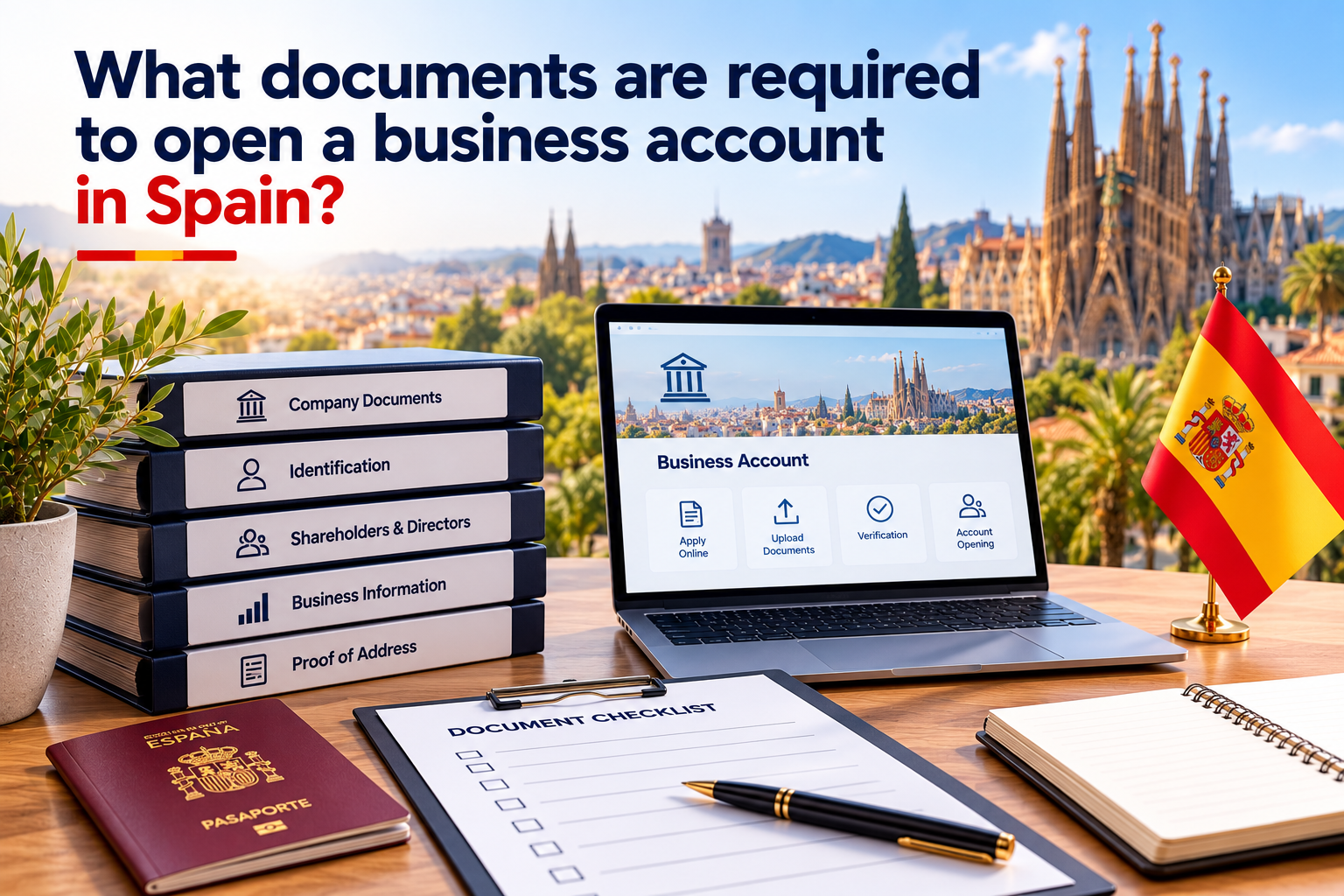
Once the company has the required documentation, it can apply for a business account.
Some regulated financial institutions allow eligible Spanish companies to submit applications online.
For businesses primarily operating in euros, a dedicated EUR IBAN with SEPA payment capabilities can help manage customer payments, supplier transfers, and other European business transactions.
The documents depend on the company structure and ownership arrangements.
For a typical Spanish SL, the requirements commonly include:
The incorporation deed and company tax identification documentation are also essential parts of the registration process.
Foreign documents may require certified translation, legalization, or an apostille.
Yes. Foreign entrepreneurs can generally establish Spanish companies, and eligible foreign-owned businesses may use electronic incorporation procedures.
A Spanish SL may be wholly owned by foreign individuals or companies.
However, foreign shareholders may need additional identification or supporting documents.
The requirements may include obtaining an NIE or NIF, verifying representation authority, and authenticating documents issued abroad.
Foreign ownership does not automatically mean that a company can be incorporated entirely remotely.
The available procedure depends on the circumstances of the founders and the applicable identification and notarial requirements.
In some circumstances, yes.
Foreign entrepreneurs may be able to complete certain incorporation procedures remotely or appoint authorized representatives to act on their behalf.
Available electronic notarial procedures may also support eligible transactions.
However, not every incorporation can be completed entirely online without additional arrangements.
Factors affecting remote incorporation include:
Entrepreneurs should confirm the available arrangements before assuming that no physical attendance will be required.
Electronic company registration can be faster than procedures involving more extensive manual administration.
Certain streamlined incorporation procedures provide accelerated processing for eligible applications.
However, the total timeframe depends on the company's circumstances.
Important factors include:
A straightforward incorporation may be completed relatively quickly once all documents are ready, while more complex applications can take longer.
Entrepreneurs should distinguish between the processing time for an electronic filing and the total time required to establish a fully operational business.
The cost depends on the legal structure, incorporation procedure, and services required.
For an SL, the statutory minimum share capital is €1.
However, entrepreneurs must also consider other expenses, including:
Eligible electronic incorporation procedures may simplify administration and reduce certain costs.
The final expense depends on the company's specific requirements.
Yes. A company registered through an authorized electronic incorporation procedure is legally recognized when the relevant statutory requirements have been satisfied.
Electronic submission does not remove the company's obligations under Spanish corporate law.
A Spanish limited company must still comply with applicable incorporation, tax, accounting, and registration requirements.
Once registered, the company has the legal status associated with its corporate structure.
Electronic incorporation can offer several benefits.
Simplified Administration
Electronic procedures can reduce duplication of information across participating authorities.
Faster Processing
Eligible applications may benefit from streamlined processing.
Convenience for Entrepreneurs
Some administrative steps can be completed without repeated visits to public offices.
Support for Foreign Investors
Electronic procedures and authorized representation arrangements may help international entrepreneurs establish Spanish businesses.
Coordinated Registration
The electronic system can facilitate communication between participating authorities.
Preparation for Digital Business Operations
Entrepreneurs can combine electronic incorporation with online accounting, invoicing, and business payment services.
After company registration, entrepreneurs must complete any remaining legal and operational requirements.
These may include:
Online incorporation is an important milestone, but it does not automatically complete every requirement for beginning commercial activities.
Yes. Some regulated financial institutions offer online business account applications for eligible Spanish companies.
The application process generally involves verifying the company and the individuals who own or control it.
Commonly requested documents include:
Foreign-owned companies may need to provide additional documents.
Approval depends on the financial institution's eligibility and compliance requirements.
Not necessarily.
A Spanish company may be able to use an eligible European IBAN issued by a regulated financial institution in another EU country.
For euro transactions, SEPA payment services provide standardized transfer capabilities across participating European countries.
Under applicable European Union rules, certain forms of IBAN discrimination are prohibited for covered euro credit transfers and direct debits.
However, companies should verify compatibility with their specific tax payments, payroll, direct debits, and other administrative requirements.
Yes. Spain provides electronic company formation procedures for eligible businesses, including certain Spanish limited companies.
CIRCE is an electronic company creation system that coordinates several incorporation and administrative procedures.
Yes. Foreign entrepreneurs may use eligible electronic incorporation procedures, subject to identification, documentation, and notarial requirements.
Depending on the circumstances, some incorporation steps may be completed remotely or through authorized representatives.
Foreign individuals commonly require an NIE for relevant company formation procedures.
A Spanish SL generally requires a public deed of incorporation executed before a notary, although eligible electronic notarial procedures may be available.
The timeframe depends on the incorporation procedure, document preparation, and administrative requirements. Eligible streamlined procedures may be faster.
The statutory minimum is €1, with additional legal obligations applying while share capital remains below €3,000.
Yes. Some regulated financial institutions allow eligible Spanish companies to apply for business accounts online.
Yes. Eligible European IBANs can support covered SEPA payments, subject to the company's specific operational requirements.
Yes. Spain offers electronic company formation procedures that allow eligible entrepreneurs to complete several registration steps digitally.
For entrepreneurs establishing a Sociedad Limitada, electronic incorporation can simplify administration and help reduce unnecessary delays.
However, the process still requires compliance with Spanish company law, identification procedures, notarial formalities, tax registration, and Commercial Registry requirements.
Foreign entrepreneurs can generally establish Spanish companies and may be able to complete parts of the process remotely, depending on their circumstances.
Once the company has been registered, opening a suitable business account is an important step in preparing for commercial operations.
For businesses primarily conducting euro transactions, an online EUR business account with SEPA payment capabilities can provide a practical solution for receiving customer payments, paying suppliers, and managing European transactions.
Looking for an Online Business Account for Your Spanish Company?
If you are registering a company in Spain online or have recently established a Spanish SL, explore online EUR business account solutions for eligible European businesses.
A dedicated EUR IBAN with SEPA payment capabilities can help your company receive payments, pay suppliers, and manage euro transactions across Europe.